
Turn the Page
A man who was 'losing his marbles' and his final attempts to chronicle his days.

One brief musing about storytelling per day (or, more likely, as frequently as I can muster).
March 23, 2026
KEEPING TRACK HAS BEEN a hallmark of the Anthony family going back to the early 1800s. In so many ways, we have been very careful to leave behind papers and items that tell our own story across the decades. Perhaps that is part of the long and winding road that led me to this space.
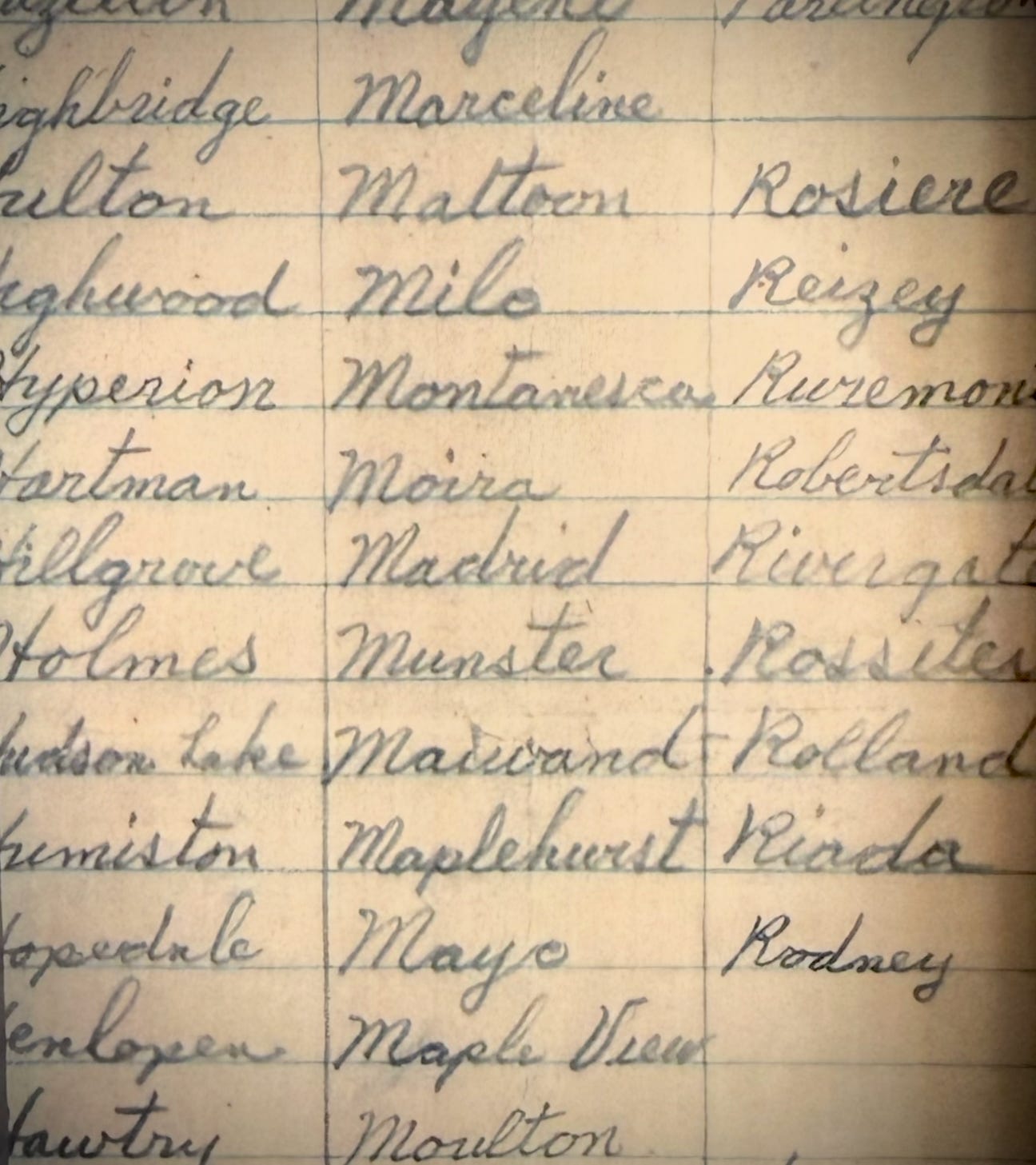
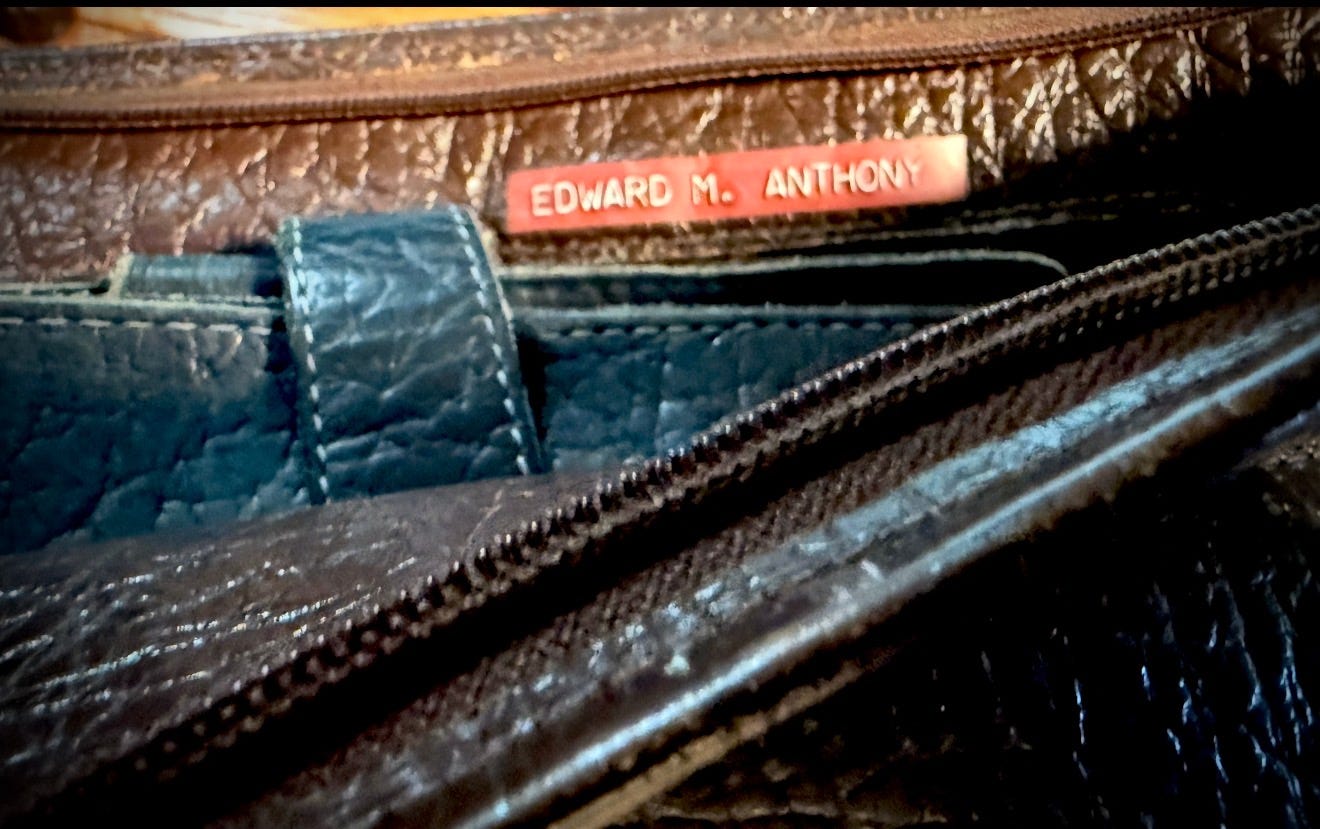
James Shearman Anthony (1794-1845), my great-great-great grandfather, was known as “the Bard of Rockport” for his writing about his community and his family. James Riley Anthony (1820-1900), my great-great-great uncle, kept marriages and deaths recorded for the family until his death. My paternal grandparents, Edward Mason Anthony Sr. (1894-1945) and Elsie (Haas) Anthony (1898-1981), were both rabid transcribers of their own writings and other ideas. She also kept handwritten ledgers of every expense, and he — an employee of the New York Central Railroad — left behind in his many papers a handwritten list of the names of Pullman sleeper cars.
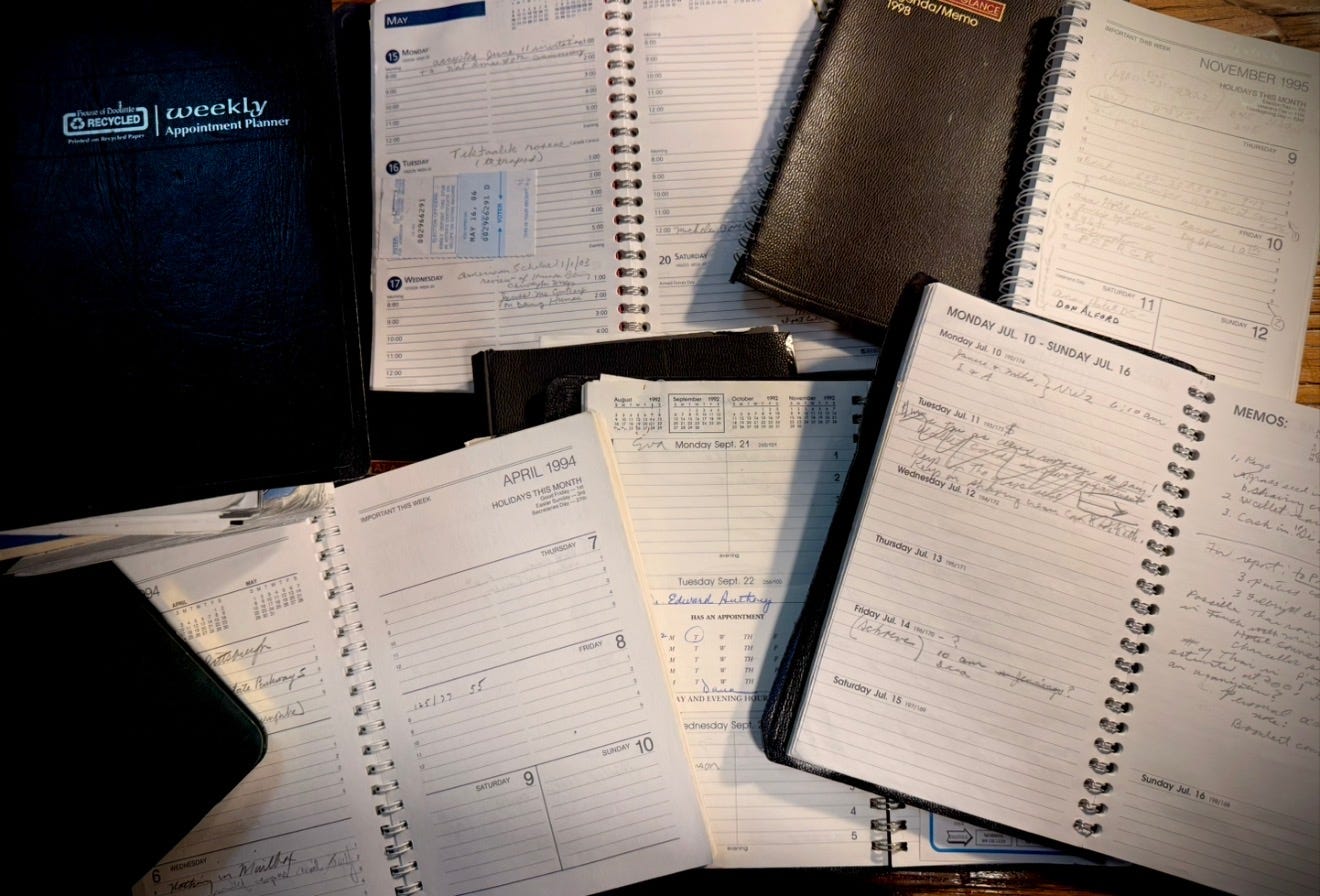
My father, Edward Mason Anthony Jr. (1922-2015), was no different. When I inherited his house and his study, both were brimming with his musings, from poetry to prose to a huge collection of his previous date books, calendars and diaries. Until he stopped when Alzheimer’s Disease descended. “I’m a man who is losing his marbles, if I ever had all of them in the first place,” he told me sardonically.
In 2012, four weeks after I wrote the essay that follows this introduction, my father fell and hit his head on the corner of a Chinese chest he and my mother had brought home from their travels in 1980. Then: hospital. Rehab. Confusion. He began his downward spiral, and dates no longer meant anything to him. His record-keeping was over.
When I delved into his date books, I realized that such items are stories of the past in themselves — many stories in one package, kind of like the paper version of walking through a cemetery. And in this particular paper cemetery from the 1980s, 1990s and 2000s, I am the only person alive today who knows many of the residents.
Today I offer you this personal read as an example of how the most prosaic and workaday of items can be gateways to the stories of a person’s life.
Jan. 15, 2012
THERE ARE FEW physical items more optimistic than a fresh, empty day planner on New Year’s Day. That breed of leather-bound beast, it seems to me, is possibility embodied -- the notion that the immediate future is a blank book of crisp empty pages, each waiting to be filled with all the things that life is about to send your way.
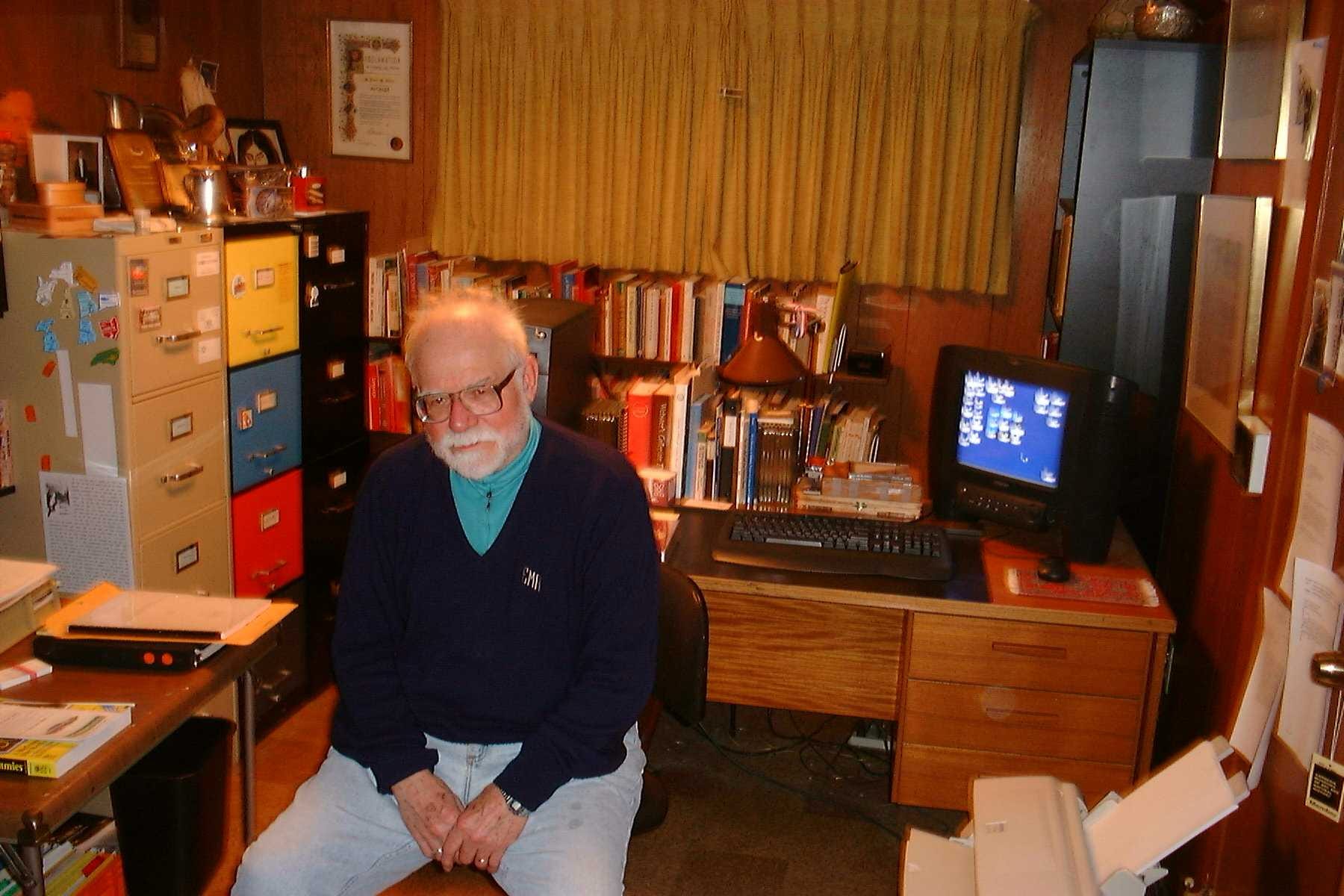
My love for stationery in general, and planners in particular, points straight back to my father, the founding chairman of the University of Pittsburgh’s linguistics department and today, at 89, a professor emeritus who struggles to remember the details of a life well lived.
From the time I was small, he was an unrepentant record keeper. I grew up playing in the closet of his study, which was filled with the glorious scent of all manner of fresh office supplies. There were multiple cans of rubber cement. There were reinforcements, those tiny donut-shaped stickers that kept notebook paper from pulling out of the binder. There were a dozen different kinds of paper, all stacked neatly in trays and boxes, ready to be inked by hand or by typewriter; my earliest drawing paper was outdated Pitt letterhead.
But in the vast kingdom of stationery that lived in my father’s supply closet, the appointment diary — what we now like to call the day planner — reigned. “Keep a journal,” he’d tell me all the time. “Keep track. Then you’ll know, when you’re old, how you spent your days.”
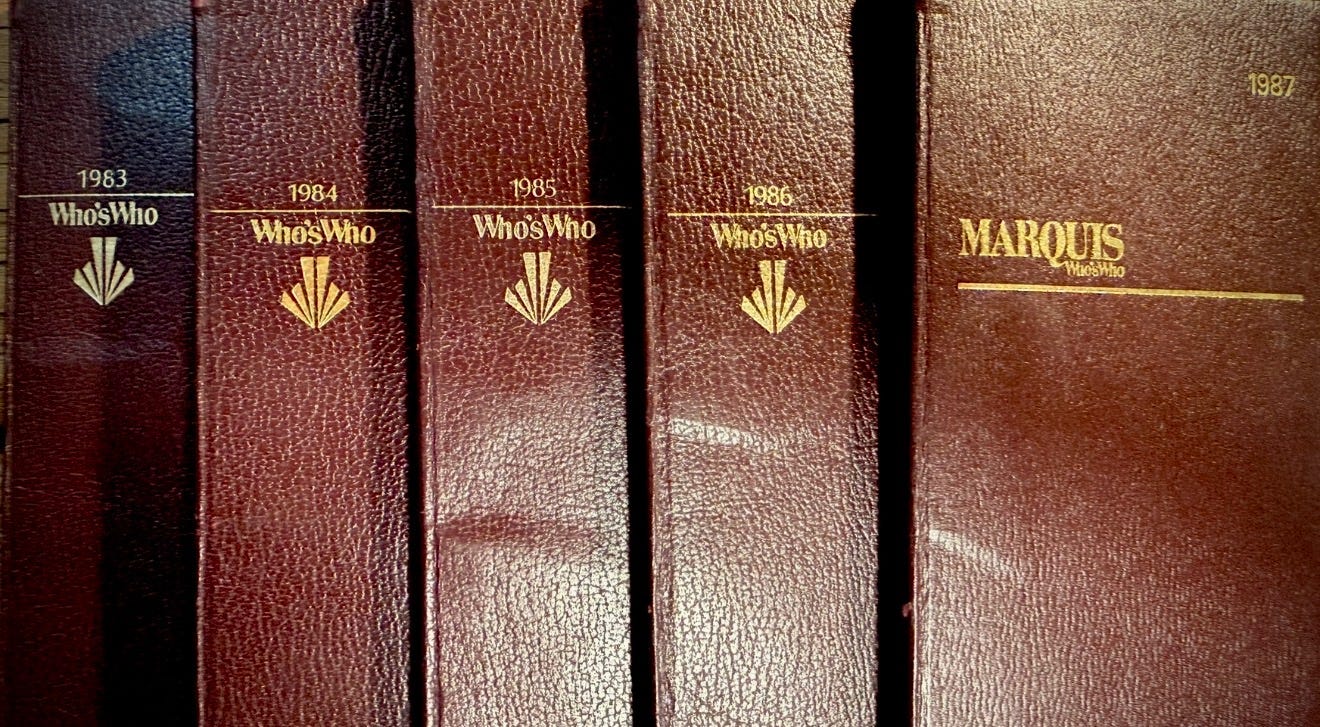
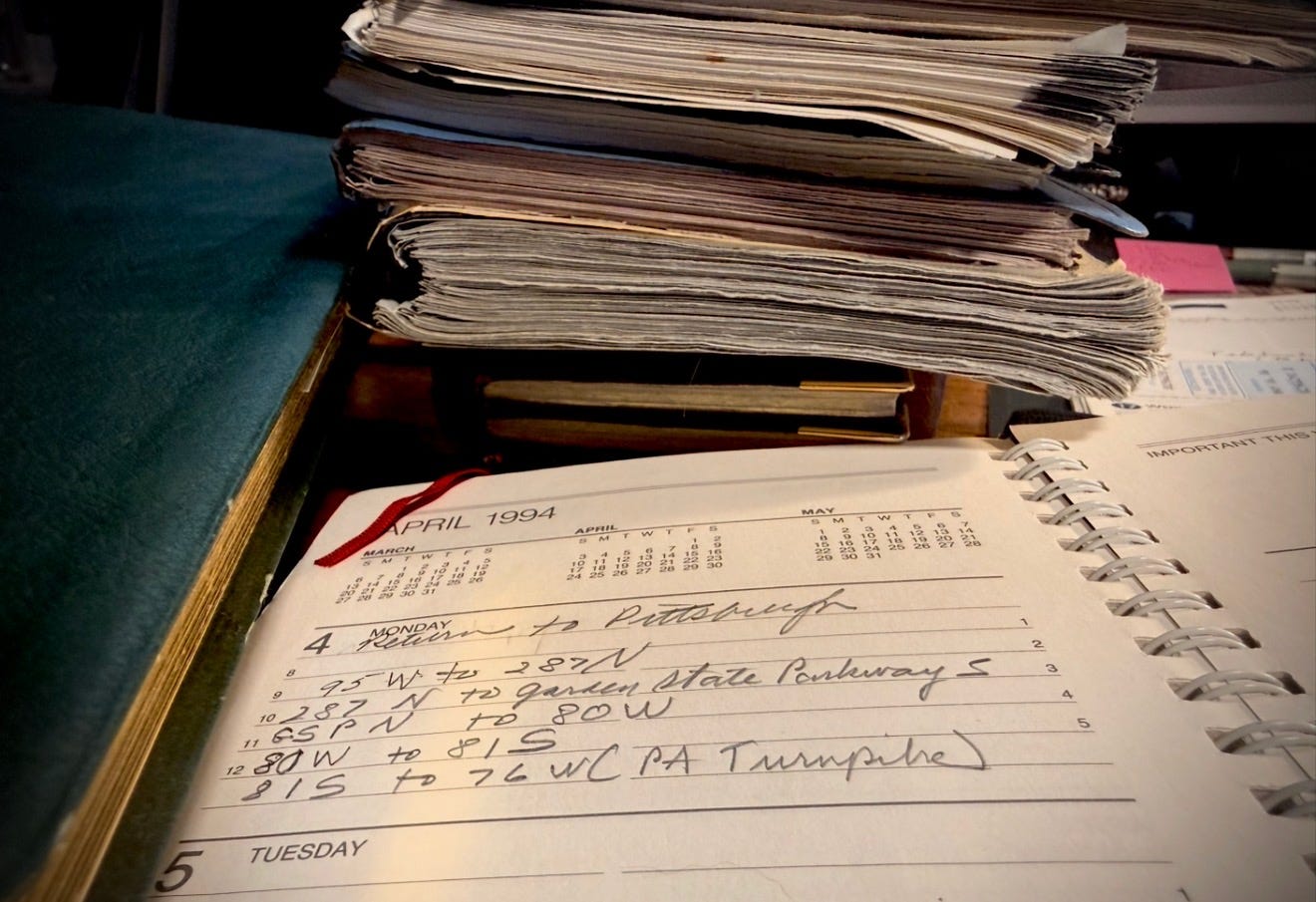
WHEN MY PARENTS moved to an “independent living” retirement community four years ago, they left much behind. Helping them pack, I came across stacks of my dad’s planners from 1983 to 2006, bound by fraying rubber bands. He wanted to get rid of them. I objected; I am a writer, and this was a trove of primary source material about the environment in which I grew up. “Keep them,” he said to me at the time. “I’m not planning to have plans at this point.” So I put them away.
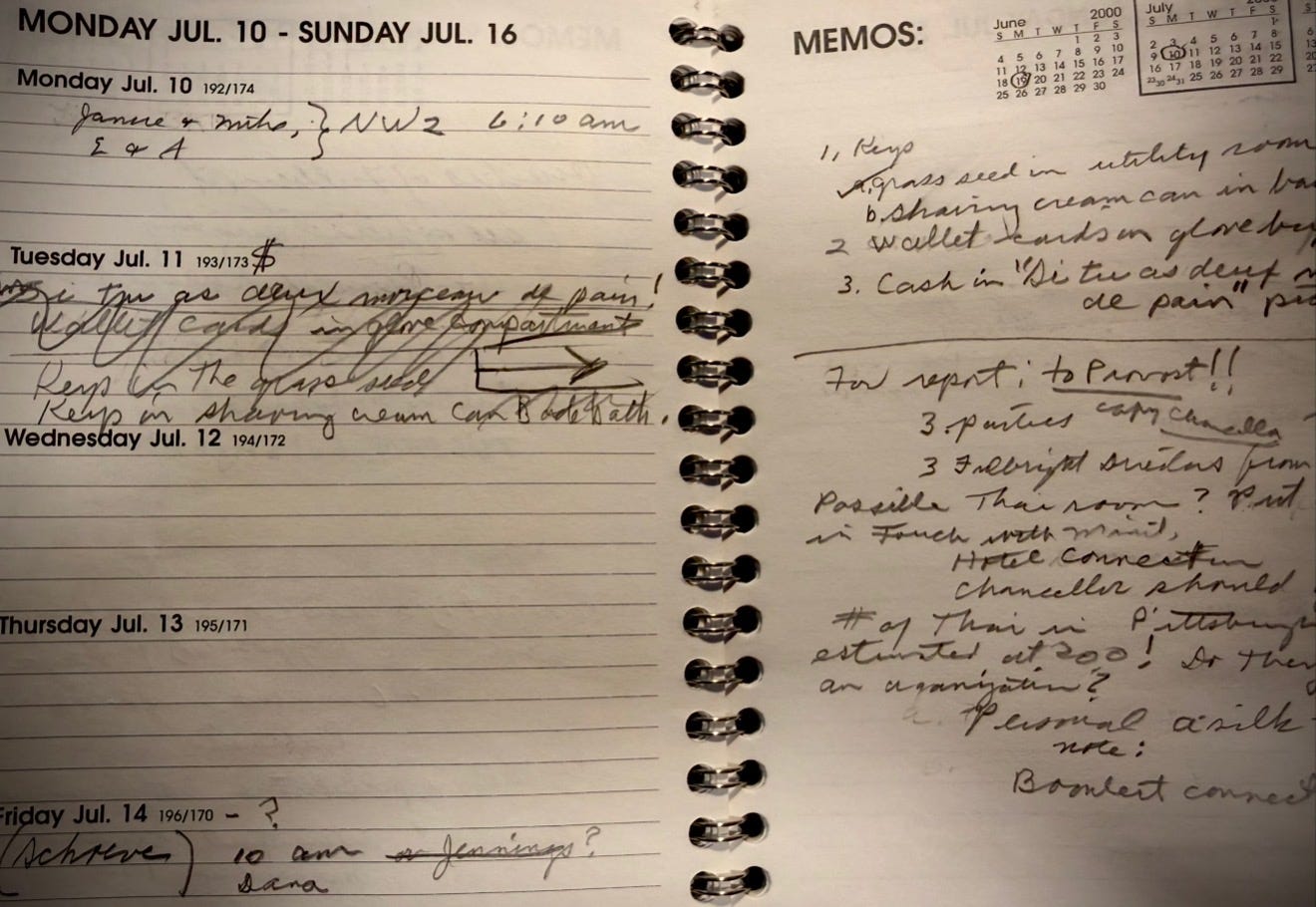
Now, as one year ends and another begins, I pull them from the closet to follow the breadcrumb trail of a busy life that so impacted my own. In his famously hard-to-read scrawl, I see slivers of a career, appointments long ago kept, personal errands long ago completed, people long ago forgotten.
Some entries are cryptic, their meaning lost. Saturday, Aug. 10, 1985: “Flyers on $50 reward distributed.”
Some are familiar and summon names from long ago, the people who passed through my adolescence in the kind of repeating cameo appearances that happen when you’re the son of academics. Tuesday, Aug. 9, 1983, 8 a.m.: “Francine re Kitamura party.”
Some jog my old memories. Sunday, Aug. 24, 1986, the day my parents drove me to my first day of college: “Ted to Penn S.U. Econolodge AARP Milesburg. 220-150 at 80 (arrive before 6).”
Some simply reinforce how much he had to do and how busy he was. “Class” ... “Dept. Meeting” ... “Lv. for Far East” ... “Japanese bankers arrive” ...
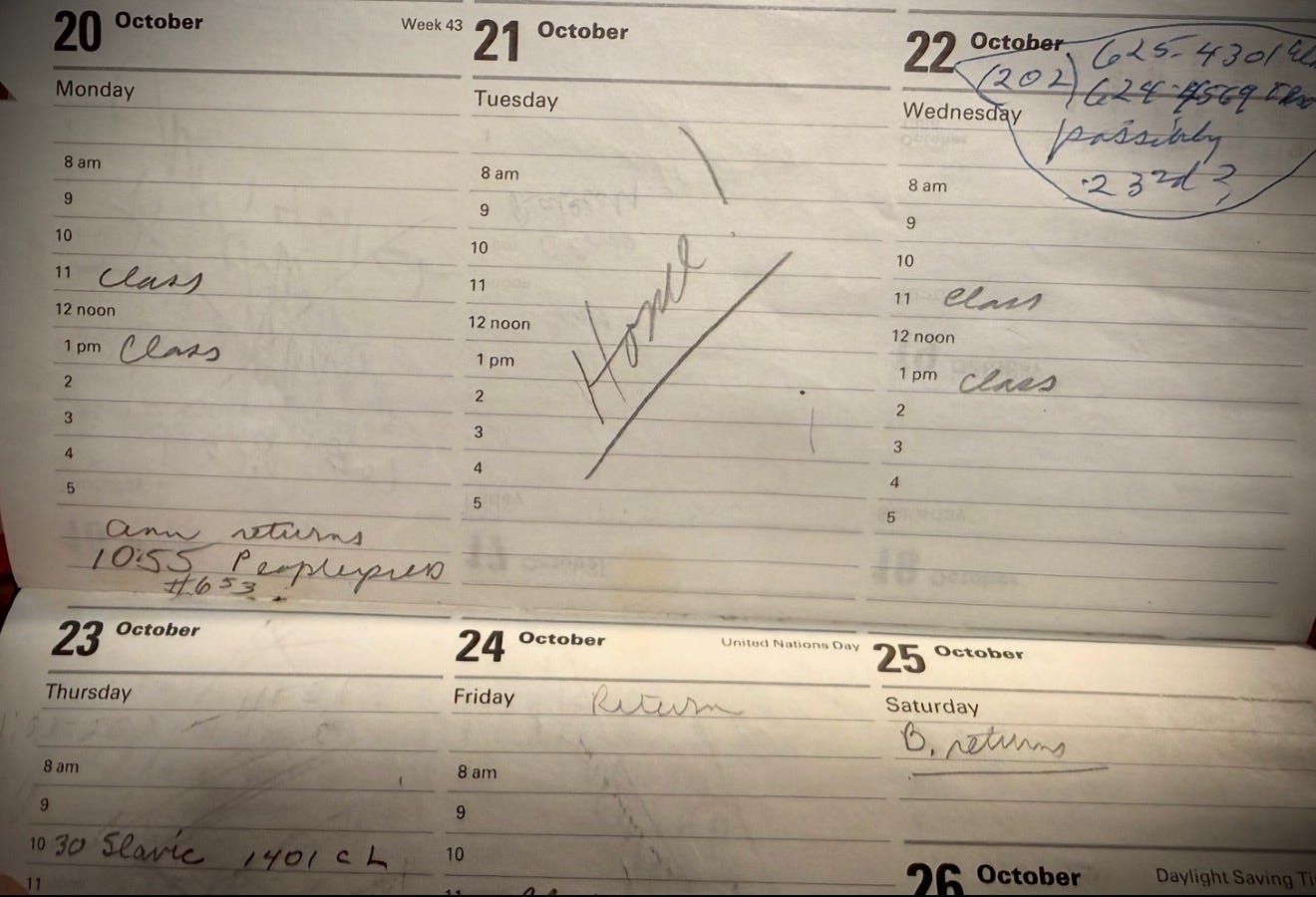
And this entry, one of my favorites, from Oct. 21, 1986: “Home!” The exclamation mark and emphasis are his.
As he ages and, in 1990, retires, the planners begin to change. More spaces between entries. More leisure activities. More random quotations from the likes of H.L. Mencken. More doctor’s appointments, even the occasional logging of a blood pressure here and there.
Tuesday, July 9, 1991, 10:15 p.m.: “All-Star Game.” Saturday, June 26, 1993: ˆ Wednesday, May 17, 2000: ˆ Saturday, July 23, 2006: “Sent $72 to Smithsonian to renew Ted’s + my subscription.”
The collection ends that year, on Dec. 31, 2006, in a nondescript Mead spiral- bound appointment book.
THE FOLLOWING SUMMER, he and my mother moved from their house of 42 years to the two-bedroom “independent living” apartment. In the time since, I have bought him a new planner each year. And each year he has lost more of his memory, and had less to do.
Today, when I ask him about events and people that once filled his planners, his face furrows, then goes blank as he struggles to retrieve them. Most times he cannot, though occasionally, when I tell him more, a light blinks on. It is as if the information remains stored on the hard drive, but the icon that opened the document has been deleted.
A few months ago, I was visiting their apartment when I saw upon his desk, hidden under a pile of papers and books, the 2010 leatherette planner I bought for him at Barnes & Noble. I flipped through it. The pages I saw were blank, but I felt no sense of possibility. That particular diary’s time had passed. It is a bittersweet combination: He cannot remember what his plans are, but it does not matter because he no longer has anything to plan.
Planning, I realize, is far more than optimism about the things that are going to happen. Planning signifies competence. It signifies trajectory. It signifies purpose. And it signifies an ability to organize things into distinct categories — the building blocks of stories. Today my father, one of the fiercest and finest intellects I’ve ever encountered, possesses those qualities only in small measure if at all.
My life nowadays is full of plans — too full. I have three simultaneous calendars going to keep track of it all. Of course, they’re appointment books no longer.
My iCal calendars are backed up on iCloud and pushed to my Macs, my iPhone, my iPad. I use software called “OmniFocus” and “DevonThink” to ensure that things don’t fall through the cracks. Perhaps this is efficiency, cold and calculating. Or maybe it’s actually sentimentality; maybe, like my father, I am keeping track so that I’ll know, when I’m old, how I spent my days.
In mid-December, I bought him a “2012 Leather Weekly Planner, Handmade in Italy,” complete with its own tiny metal pen. This diary is shaped to fit in the pocket of the suit coat he no longer wears. It was to be a Christmas present, but I did not give it to him. It sits on my desk, unopened.
We put so much faith in the calendar, and yet so often we misunderstand it completely. “We must not allow the clock and the calendar to blind us to the fact that each moment of life is a miracle and a mystery,” H.G. Wells, the author of, appropriately enough, “The Time Machine,” once wrote. But I think he got it wrong.
Perhaps the calendar, gazed upon from a distance, actually illuminates the miracle and mystery of life. Populated with our personal details, it accompanies us. It is our signpost, our road map, our book of moments. It is available so we can make sense of the days that we remember and, perhaps, a vault of permanence for the days we do not.
I think I shall give my father the 2012 planner after all. If an empty datebook is about possibility, about things that might still happen in a life, how could I not give him that? I’ll take it over to him tomorrow, I think. Maybe early afternoon — say, 2:30 p.m. At least, that’s my plan.
And now, Bob Seger and the Silver Bullet Band.
To Ponder
Do you have an old datebook — even one from you. What stories do you think you could find in it?
Imagine you’re writing a profile of someone who recently died. How could an old day planner help inform it or enrich it?
Have you told stories about memory and dementia before? What approaches have you taken?
This is beautifully done, it turns something as ordinary as a planner into something completely different. I loved the idea of those datebooks as a kind of “paper cemetery”, not just records, but fragments of a life that only you now fully understand. There’s something both comforting and unsettling in that. A moving piece, and a powerful reminder that even the most routine records can become deeply meaningful over time.