
The Joker
April Fool's Day and the stories we tell.

One brief musing about storytelling per day (or, more likely, as frequently as I can muster).
April 1, 2026
I RECEIVED AN EMAIL this morning from my hot-sauce agent. I have several hot-sauce agents, actually, but this one vaulted to the forefront recently with several absolutely delicious sauces that burned my face off without sacrificing taste in the process.
No more, apparently. The Harmacy Hot Sauce Company is, as of today, exiting the hot-sauce business for milder pastures. To wit:
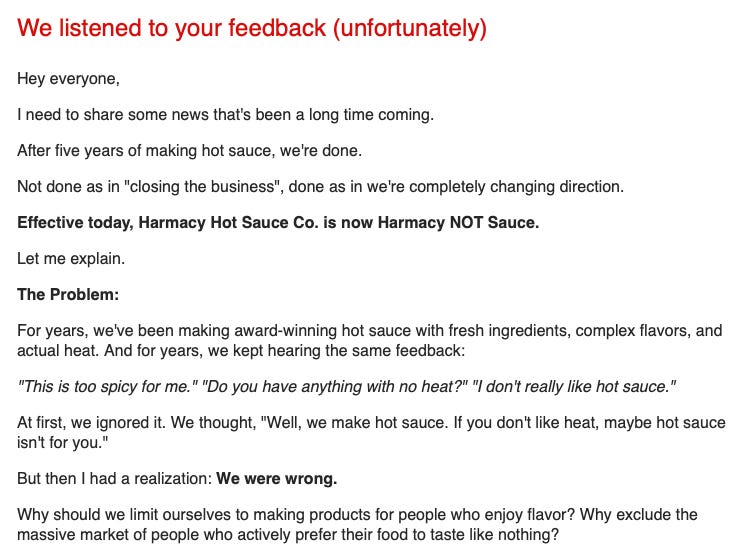
They also changed their name.

I was beside myself, being the hot-sauce obsessive that I am. But it soon became obvious that this was an April Fool’s joke, it being April 1 and all. That fact became even more evident as the language deliberately edged into wink-nudge sarcasm about what might be replacing said hot sauces.
“From now on,” they said, “we’re only making products for people who think black pepper is ‘a bit much.’”

It got me to thinking: While many April Fool’s jokes are pranks, some of them are storytelling, pure and simple. Those are the interesting ones. Best in Show of this category — forever, no contest — is Sports Illustrated. On April 1, 1985, at the beginning of the baseball season, it ran a full-on profile — by George Plimpton, no less — about a prodigious pitcher named Sidd Finch. Said Sidd played barefoot, practiced yoga and threw pitches for the New York Mets that clocked in at 153 mph — basically nearly 50 mph faster than the fasted pitch ever recorded.
This is, of course, absurd. But it was Plimpton’s storytelling — and his use of real-life supporting characters like Len Dykstra, Mel Stottlemyre and then-Commissioner of Baseball Peter Ueberroth — that sealed the deal.

Don’t get me wrong: I am not advocating any kind of concocted stories purporting to be fact in any publication. Ever. But the sheer scope of the Sidd (as in Siddhartha) Finch tall tale took the baseball-fan world by storm for a few days in the pre-internet era precisely because of Plimpton’s adeptness at spinning a tale. No obtuse prank for the Paper Lion.
Sometimes, ill-advised April Fool’s Day storytelling goes seriously awry. Witness the Boston TV station that, in 1980, ran a news item that alleged that a hill in the town of Milton was actually a volcano and was erupting. That produced local panic, a news director’s dismissal and a slap from the FCC.
You can find all kinds of other examples — particularly this afternoon and evening, when the various shenanigans begin to find their way around online.
I raise this issue today not only because it’s April Fool’s Day, but for a larger, more critical reason. The April Fool’s jokes that succeed in fooling people — or that are remembered beyond the day — are usually story-based rather than, say, dumping water on people as they walk through a door. Why? Because effective stories are potent beasts. They touch us in ways that are engaging and that help us want to believe.
That seems to me to be something we want to remember in today’s world, where we’re awash with stories and the sophisticated tools to tell them easily and in ways that present as credible. Sometimes we lose sight of the place where reality ends and deliberately calibrated fiction begins.
In this respect, April Fool’s Day is an excellent national case study in storytelling literacy. Were you fooled at all today? If so, think about why, and how, and how the spinning of a good yarn might have played a role.
And now, the Steve Miller Band.
To Ponder:
Have you ever pulled an April Fool’s prank? If so, what kind of storytelling was involved?
What has fooled you on this day in the past? Why?
If you’ve read Plimpton’s Sidd Finch story from the link above, what do you think was most persuasive part of the storytelling to make so many people believe it was real? The tone? The quotes? The platform? The blending of real and fictional?
If you’re interested in reading about how everyday life and unusual things shape us, check out my other Substack, Unsorted but Significant:
