
The Echo
What to leave 'em with.

One brief musing about storytelling per day (or, more likely, as frequently as I can muster).
Feb. 22, 2026
COMPARE THESE TWO endings to very different stories.
The first:
“A preliminary hearing is scheduled for next Tuesday, a court administrator said.”
The second:
"So we beat on, boats against the current, borne back ceaselessly into the past.”
The first is a composite of many stories that I (and any number of us) wrote early in my career as a police reporter. The second, as I’m sure many of you know, is the last line from Fitzgerald’s The Great Gatsby.
I ask you a question: Which would you like to echo in your head when you’re done reading something?
I know the answer is obvious. I also know the comparison is kind of silly. But writers — particularly in daily journalism — don’t think enough about endings and what to leave the reader with. I call it “the echo.”
I’m not going to pretend that every single story, right down to the procedural ones, deserves a sharp coda. But more of them do than we might realize. And the ending of a story gives you the opportunity to say something about your material rather than just have it taper off in inverted-pyramid style.
There are countless choices for endings. Here are a few:
The strong quote — possibly one from someone you’ve already quoted in the story, but not necessarily. Something that sums up or assesses or conveys feeling. When we think of endings, this is the most obvious and the most frequent go-to. Journalists tend to call it a “kicker quote.” It often works best if you save a tiny bit of good stuff to deliver at the conclusion. Like a dessert.
The sumup/synthesis — your synopsis of what it means or what you’ve said. Be careful not to make this an “And in conclusion …” type of feel, which is cliché. And please, please, please, don’t end with “only time will tell.”
The reference back to something earlier — come back to a point you’ve made or something someone’s said and use it as a springboard to write an ending. That will give the reader a sense of closure and reward them for reading this far.
That last thought is important, I think. Our attention spans are so short, and our time so fragmented, that readers who have stayed for the entire ride are kind of owed something. It can be something tiny, but that sense of — though I hate the word — “closure” is important and can both increase reader loyalty in the future (if that’s what you’re going for) and help someone remember the story you wrote amid the cacophony of daily media consumption.
Here’s one example I’ll share from my own writing. It may not be everyone’s cup of tea, but it demonstrates my point. I was writing from the U.N. General Assembly in 2023, raising the question: Is the world governable?
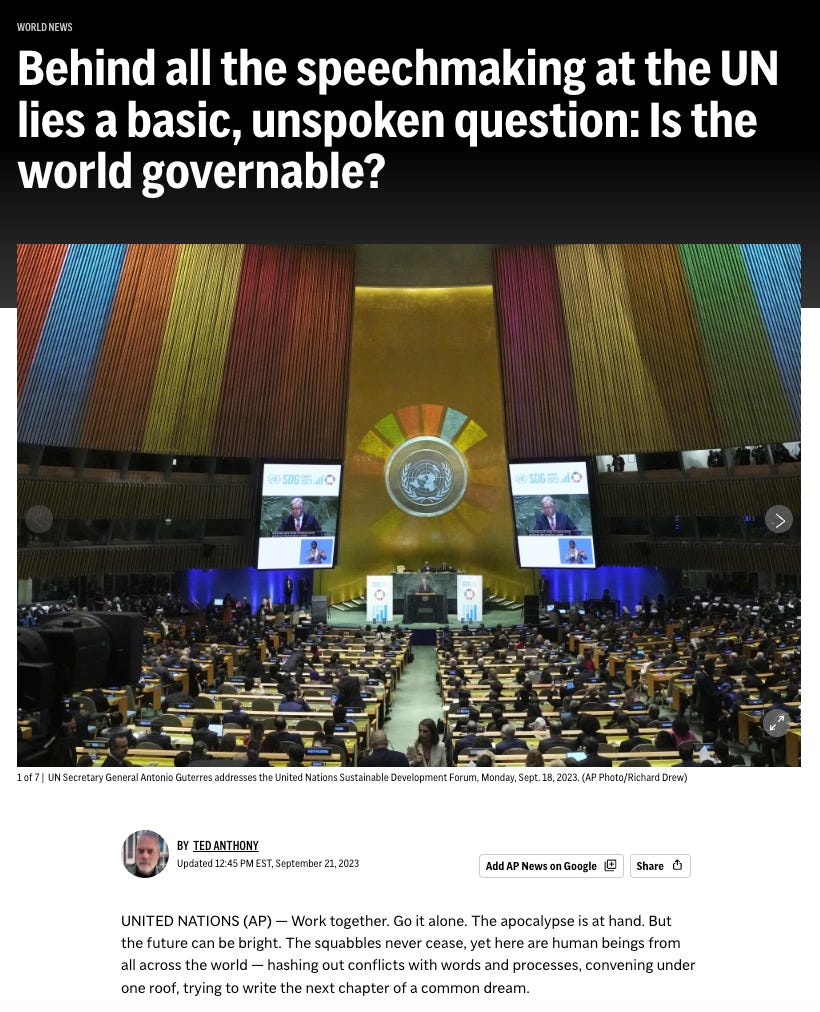
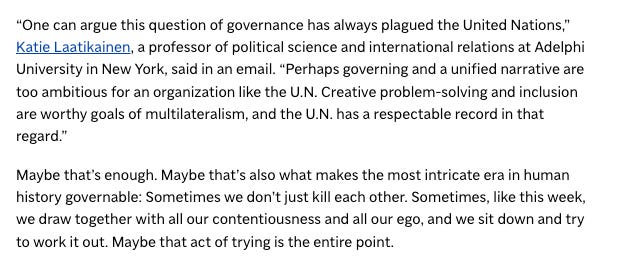
After exploring the issue for what my editor thought was far too long, quoting various world leaders and the like, I came back to what is kind of both a sumup and a synthesis of the possibilities of what might be going on here. Not perfect, by any means, but a way to leave the reader with a gift and … an echo.
Consider, then, your echo. It may open new doors and even help you understand your own story better as you synthesize what you’ve written.
Until then, I’ll leave you with this: A preliminary hearing is scheduled for next Tuesday, a court administrator said.
And now, Pink Floyd.
To Ponder
What might you pull from your story or notes to come back to at the end for impact?
What do you want your reader to take away from the story? The ending should try to speak to that whenever possible.
Do you want to choose a quote or say it yourself? Both are viable, though each can have a very different effect.
Here’s another take on managing endings that may be useful to you.