
Rhythm Is Gonna Get You
Consonants, cadence and Captain Kirk: Thinking about how stories sound.

One musing about storytelling per day (or, more likely, as frequently as I can muster).
Jan. 24, 2026
CONSIDER THESE THREE sentences. Read them out loud. Let them roll off your tongue.
The Word was there at the very outset. It definitely wasn’t new. It had always existed, and in fact it was God who had been speaking all along.
Back in those days, there were definitely both good periods and bad periods in the 18th-century metropolises of Paris and London.
Maybe you should avoid making self-centered queries about what you can get out of being an American, but instead consider offering something in return as a more generous alternative.
Now try these more familiar versions of the identical content. They might be a bit more recognizable. Again, read them aloud.
In the beginning was the Word, and the Word was with God, and the Word was God.
It was the best of times, it was the worst of times.
Ask not what your country can do for you — ask what you can do for your country.
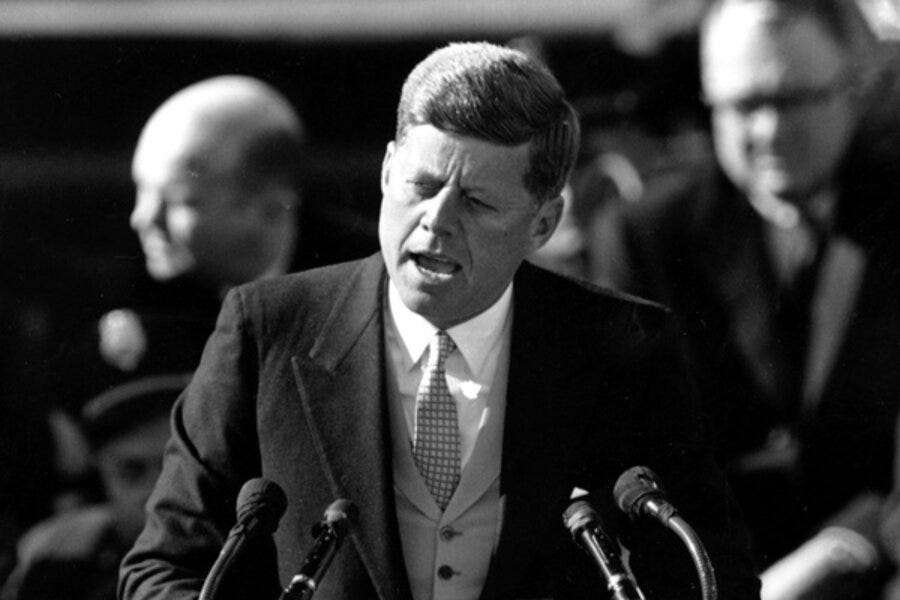
What makes these three immortal lines stand out is pretty obvious. Rhythm. Cadence. Word choice (remember the word-substitution self-edit) and word order. How things SOUND, in short. Radio and TV journalists and podcasters are attuned to this throughout their workdays. Writers? Less so.
Without getting into an extended treatise about this, I wanted to use today’s space to talk a bit about what works in writing when it comes to rhythm.
My first lesson in rhythm and cadence in writing came from my earliest journalism mentor, David S. Martin, the central Pennsylvania correspondent for The Associated Press in the late 1980s. He helped me, then a Penn State student, develop some of my writing instincts (not to mention fostering my own deep desire to work for the AP). He said to me once, “You always have to think about how stories hit the ear.” I asked him what he meant and he dragged out one of his favorite examples, a story he’d written several months earlier.
It was about how suburbs were encroaching on farmland. David told me he had interviewed a farmer named Clyde Strock and been struck (see what I did there?) by the mellifluousness of the man’s name.
His first crack at an opening paragraph, he told me, went something like this:
MECHANICSBURG, Pa. — Cumberland County farmer Clyde Strock looks out upon what used to be his neighbors’ farmland but now sees neighborhoods of suburban homes in every direction.
Pretty workable. But David, who has a great ear for how things sound, decided to hone. So he sat down at his TRS-80 Model 100 and carved. He chipped. He whittled. He sanded. Finally, he arrived at this lede:
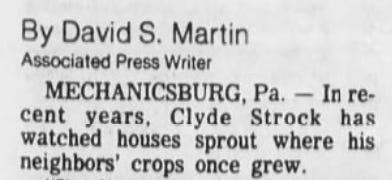
Read that out loud. And consider not only the cadence, which is pleasingly taut, but the sounds of the words too:
“Clyde” and “Strock” — can’t really control this one, since it’s his name, but it starts and ends with very pleasing hard “k” sounds. Lesson in this case (not always true): Use the name in the lede if you can.
“houses” and “sprout” — they share an “ow” sound and fit together like puzzle pieces. Lesson: Bounce them off each other.
“neighbors’ crops once grew” — rich with sounds that reflect each other. “Neighbors’ crops” fits together nicely, as do the closing sounds of “crops once.” And “neighbors’ crops once grew” is flat-out fun to say. Lesson: Just follow what your ears tell you.
These decisions that David made, coupled with the whittling that honed it to a nub, made this an opening paragraph I remember vividly 38 years later. That’s staying power. (From the vantage point of today, I might have taken it one step further, eliminating even more of the filler sounds: “Clyde Strock watches houses sprout where neighbors’ crops once grew.”)
Then there’s the ol’ “Shotguns boom. Pigeons die.” This one is from 1990, written by my long-ago Harrisburg Patriot-News colleague John M.R. Bull.
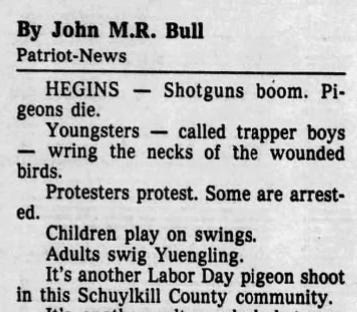
Breaking it down:
“Shotguns boom. Pigeons die.” — notice the exact same rhythm in the three-syllable sentences.
“wring” and “swings” and “swig Yuengling” — not rhymes, exactly, but callouts to rhyming words across the introductory paragraphs. (For the uninitiated, Yuengling is an iconic central Pennsylvania beer.)
“swig” and “swing” — matching similar sounds to tie the words together.
I typically gravitate toward less staccato (despite my affinity for William Shatner, which you’ll see below), so I might have rendered it this way:
HEGINS — Shotguns boom. Pigeons die.
Youngsters, called trapper boys, wring the necks of the wounded birds. Protesters protest. Some are arrested. Children play on swings. Adults swig Yuengling.
It’s another Labor Day pigeon shoot in this Schuylkill County community.
That consolidates the sweep of random imagery into a single graf to give it more purpose, to my mind — and gets to the nut graf more quickly. Nevertheless, John’s vivid imagery, coupled with his careful and sound-conscious word choices, made for something memorable beyond the moment.
The last concrete example we’ll consider is more low-key — The New York Times’ lead on the burial of John F. Kennedy after his assassination in 1963.
In those days, “serious” newspaper writing sometimes leaned toward a writing style that favored multiple $10 words and long introductory clauses like, “In a surprise move designed to turn back stalwart revolutionary forces that threatened his uneven three-year leadership of this humid central African nation …” (I made that up, but you get the gist.)
So with that in mind, consider what could have been written here:
Three days after an assassin’s bullet cut short his presidency and his life, John F. Kennedy was buried in Arlington National Cemetery today as a shattered nation mourned and his grieving family gathered to say goodbye.
Perfectly fine. A teensy bit cluttered, perhaps, but for sure serviceable. This, though, needed to be a lede for the ages.
So, going with the rule that the more momentous the event, the simpler the writing, Tom Wicker of The New York Times came up with this stark and memorable lead suitable for history.
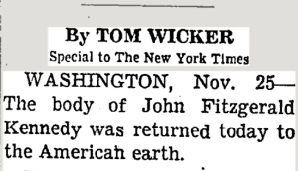
Say it out loud. Listen to how it sounds. Hear how it lands.
And try not to think of the editor who once, when I held this up as effective and poetic at a workshop, said, “In fairness, he wasn’t technically returned to the earth. Was he really there in the first place?”
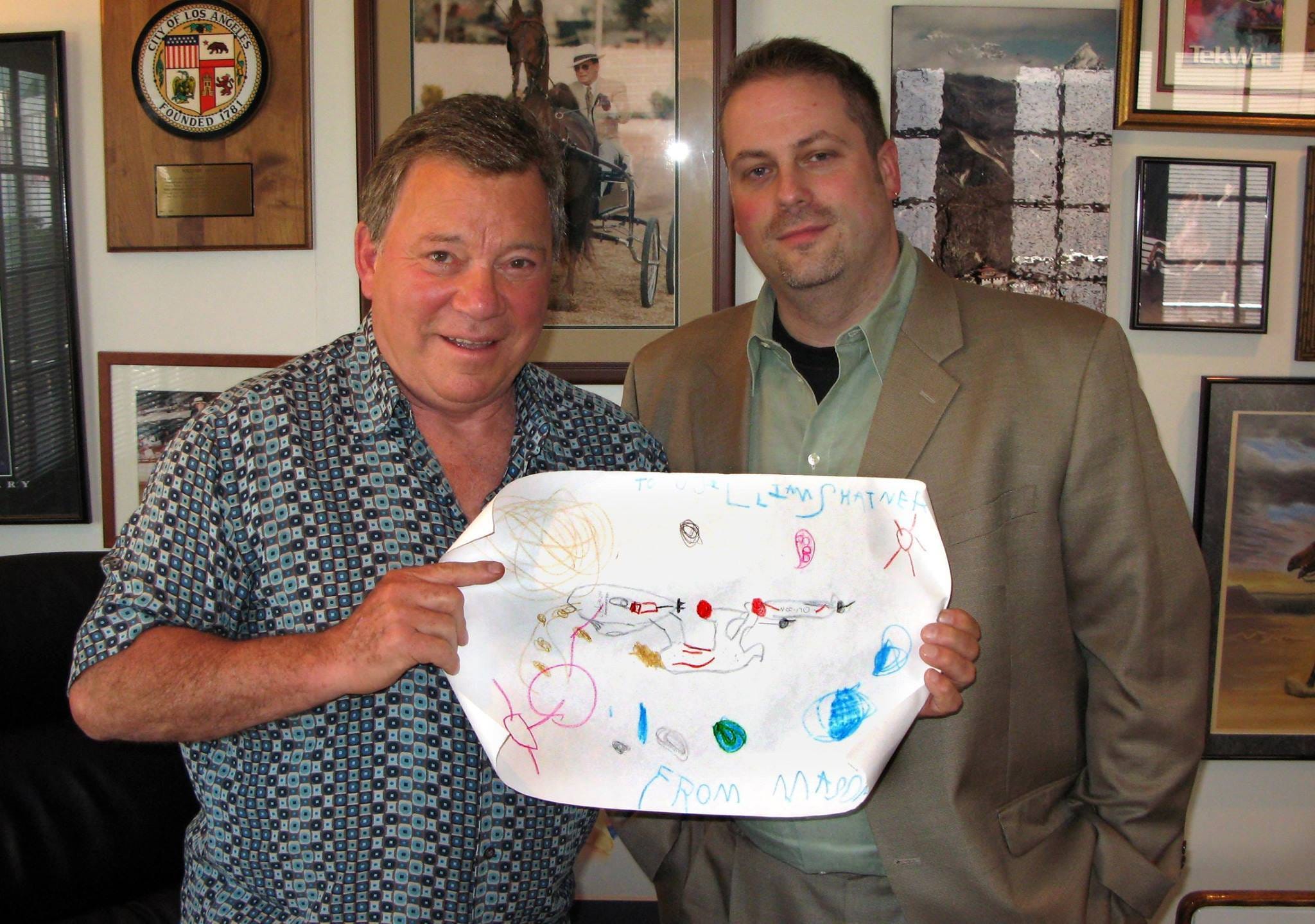
ANYONE WHO HAS come within 10 miles of me knows my admiration for William Shatner is boundless. It started when I was a toddler with my lifelong adoration of “Star Trek,” but it came to extend far beyond that. I actually got to spend an entire day with him in 2008 for a profile, and I gave him my 5-year-old son’s drawing of the USS Enterprise (above).
People love to make fun of Shatner because they say he talks. Like this. Pausing in short-sentence bursts. And then spoutingoutlongsentencestovaryhisdelivery.
He has, it’s true, dabbled in that. But it’s overstated, as parody generally is. I found Shatner in real life to be a fascinating version of this. He starts a sentence not knowing where it’s going to go, and he builds it — in thought, detail and enthusiasm — as he goes along. This creates a unique start-stop flavor that is hugely engaging when you’re eating sushi across from him.
Here’s a great example of it from 1967, his second year as Capt. James T. Kirk. He took a great piece of monologue writing and made it unforgettable.
The lesson here is related to those examples of writing above: Vary your sentence structure (we’ll delve into that more another time). Pause for effect when needed. Choose words (note “catgut” in the above example) that convey meaning or emphasis in their sound, too. And arrange them in ways that land with the most impact.
I will leave you with two workaday examples from my own recent days. The first one comes from an entry in this very newsletter. Consider the different ways the first example (my first try) and the second one (my edit) sound. Which sounds more conversational and impactful? Which sounds process-y?
We go every few days to the Boron station on that corner …
Every few days, we go to the Boron station on that corner …
And this one, which solves the problem the same way.
State television in recent days has aired …
In recent days, state television has aired …
Either one is fine. The first one is serviceable, particularly if you’re just trying to get information across. But the second one is more natural, more like how the mouth would say it and the ear would receive it. A tiny point, but they can add up.
And in a dizzying attention economy where we’re all trying to punch through the static, things that at first seem tiny — rhythm, cadence, delivery, sound — can be crucial ingredients in the recipe of encouraging people to listen to what you have to say.
Dammit, I guess I did get into an extended treatise about this after all.
And now … Gloria Estefan and Miami Sound Machine.
To Ponder
What kinds of writing feature rhythm and cadence that have struck you? What sounds do you gravitate toward?
Have you ever considered that how poetry sounds and feels might inform your prose? Pick a poem that uses out-loud language effectively.
Do you read your work out loud? Would you be willing to try it?
Agree with your rewrite, “…eliminating even more filler words,” and all the good advice here! Before publication, I read my 178-page book out loud three times. People thought I was crazy, yet I cut huge swaths of repetitive text. Now readers consume the entire book during morning coffee.
When I applied for a writing award, I made a little video about it. Sharing here in case you are interested: https://kategoggin.net/wp-content/uploads/2025/05/Center-for-Plain-Language-Finalist-Post_final_5_10_2025-1.mp4
Thank you. I am enjoying your posts.
All things lead to Star Trek, Ted. Seriously: Advice not often shared. Get these columns to cub reporters.