
Pinch Me
Storytelling Snapshot: A two-finger gesture reveals the continuity in the universe.

One musing about storytelling per day (or, more likely, as frequently as I can muster).
Feb. 7, 2026
A FEW MONTHS ago, my sister handed me a family photograph to look at. It was one of those Instamatic prints from the 1970s with curved edges and a pebbled, slightly sticky surface that felt like an old Barcalounger upon which someone had spilled a pouch of Capri-Sun.
The photo was fuzzy from exposure to the sun over the decades and lack of focus in the first place. I wanted to see more detail so I did what we always do these days when we want to see more detail on a photo: I touched the middle of it and pinched outward.
Which, of course, accomplished nothing — because it was, as I say, a paper Instamatic photo print from the 80s.
But it illustrated an important point. After just 19 years of iPhones, we are attuned as a culture to expect and demand more detail in our photos as we zoom. We pinch to know more.
That’s what attracted me about the work of an artist on Instagram called raincloudstories, the handle for Paul Ribera.
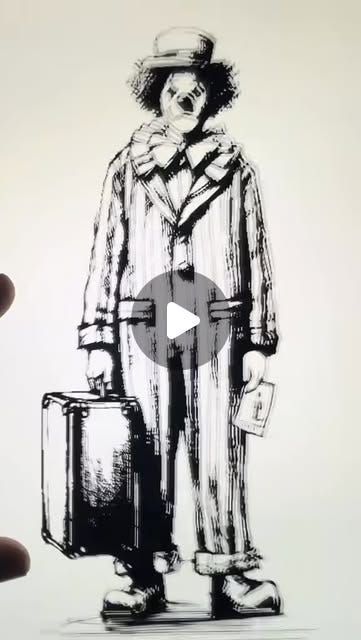
In his hands, drawings become entire (and sometimes uncomfortable) worlds, set to the soundtracks of popular songs that drive the narrative. Where a cinematographer might use a pan shot, Ribera creates a “pinch shot,” using the act of phone-screen reduction and expansion as a narrative engine. The coolest part of this is when the pinching moves the viewer not only through the space of the drawings but through time as well. Check this one out (explicit language and imagery alert):
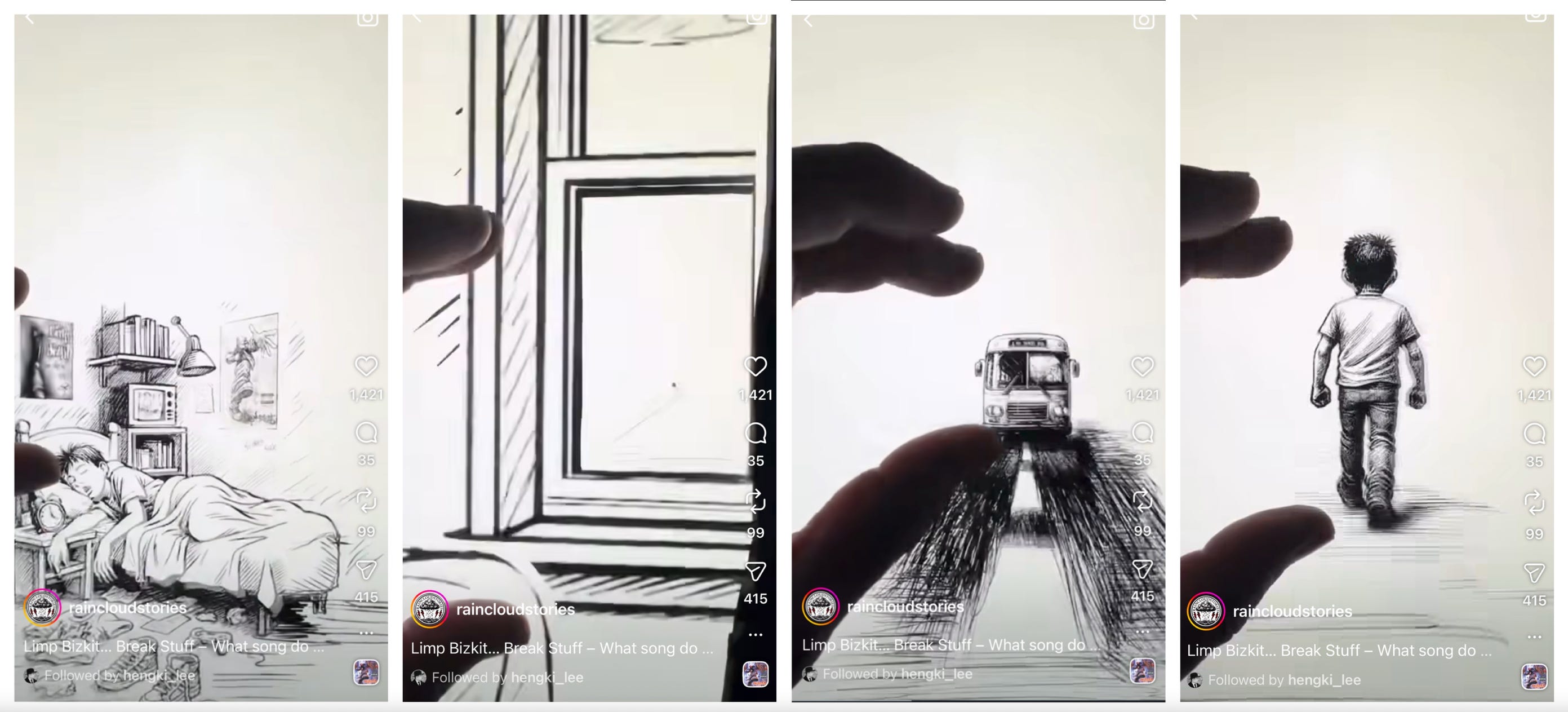
In this reel, “Break Stuff” by Limp Bizkit takes us through the day of a disaffected teenage boy. Each “pinch” of the screen makes his world larger and him more sulky and angry. At one point, the pinching hand (never has a deux ex machina felt more familiar to our everyday lives) pinches in from the kid’s bedroom window and zooms until it finds him a bit later, at the bus stop waiting for his bus. That was the part of moving through time that struck me most.
What really shook my world about Ribera’s work — and the work of anyone who is also operating in this realm, forgive me if I haven’t found you yet — is that it arguably invents an entirely new art form, or at least a robust narrative technique. It takes an act we already do instinctively — so instinctively that I, at age 57, tried to do it on paper photo — and turns it into what is literally a “page-turner” for the digital era. He changes the act of pinching into its own form of art and curation — the visible hand theory, if you will. (One wonders what this would look like on a big-screen TV with a giant hand directing the universe.)
Now, let’s check out how he used pinching to tell a heartfelt story in this Pearl Jam video. Having watched it, I now simply can’t see how that story could have been told any other way.
LET’S LOOK AT at a few examples in film where what would (upon the birth of the iPhone) become what I’m calling the “pinch” effect is deployed. (Film professionals call it several things, including a “tracking shot.”)
Here is one of the best-known shots of pre-sound cinema, from the 1927 movie “Wings.” As you watch this sequence, think of it as an iPhone photo and you pinching to move through the detail (without the visible hand, of course). Cinematographers through the decades — including directors of photography in high-budget action movies of the past generation or two — have been inspired by this shot.
Here’s one of the most famous shots, from the early minutes of “Citizen Kane.” The boy who will grow up to be the film’s subject, Charles Foster Kane, is out playing raucously in the snow. We see a close-up of him before the camera “pinches out” through a window and comes inside the house, where the boy’s life is being signed away as he remains visible and oblivious outside the window in the background. The groundbreaking Welles was renowned for deep shots in which several things were happening at once, a technique that approximated the actual world better than earlier movies did.
And check this out, from the beginning of “Star Trek: First Contact” (1996), in which an intimate close-up pans back — pinches out, if you will — from a main character’s iris to show the vast context of a giant ship of aliens that want to erase all individuality. The shot, the way it’s done, illustrates that dramatically. But I’d ask you to think of the act of pinching a photo on your phone while you watch. (Just the first 25 seconds or so will do.)
BEFORE YOU GO, I want to take a brief pivot into philosophy and perhaps even a bit of theology.
I confess to spells of mental vertigo when I watch Ribera’s work. It’s the same kind of slight psychological dizziness I felt as a kid when I read Dr. Seuss’ “Horton Hears a Who” and realized that, just as the denizens of Whoville lived on a dust speck sitting upon a clover that Horton the Elephant wanted to protect, the implication was that our entire reality could be a dust speck on someone else’s world.
This notion that Ribera introduces — pinching your way through a metaphorical camera roll as a way of navigating the universe and making the realms of the physical world and the mind overlap — suggests that everything is connected. As John Steinbeck’s Tom Joad put it, paraphrasing many others before him: “Well, maybe it’s like Casy says. A fellow ain’t got a soul of his own, just a little piece of a big soul, the one big soul that belongs to everybody.”
I raise this not to bring religion into things, though spirituality is ever-present in most storytelling. I raise it to make this assertion: Good storytelling describes reality accurately, evocatively, even poetically. But great storytelling makes you wonder about reality’s edges. This work, I admit, made me wonder: Is our entire universe connected in some way and there for the pinching?
Thanks for staying with me through that digression. I’ll close with this, which has bothered me ever since I started writing this piece: How can you pinch outward? Isn’t that an oxymoron?
And now, Barenaked Ladies.
To Ponder
When you watch some of Ribera’s work, do story forms come to mind? Do you see new ways of thinking about storytelling in light of his art?
Can you think of more analogs in the past to the “pinch” in this work? I posted three — I’d love to see more examples that evoke this.
How could such a technique be used to tell a nonfiction story? Could it?
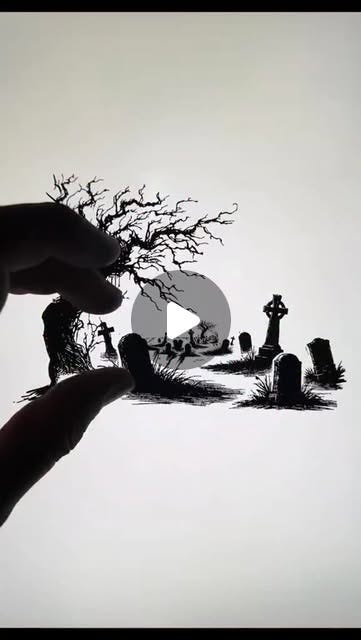
One extra treat from Paul Ribera. Follow him. It’s pretty amazing stuff.
Ideas may come In a Pinch (and friends can be found that way), Pinch Me 'cause I've lost my reality, A pinch of salt for taste, or over the shoulder to banish bad luck. Your posting today was brilliant Ted. The final video circled my noggin like buzzards searched for dead meat – then a memory surfaced of a favourite comedy troupe Kids in the Hall (a must watch for my three sons). This scene, among many memorable skits, takes 'pinch me' to another place again.
https://www.youtube.com/watch?v=8t4pmlHRokg