
I Fall to Pieces
Can my struggles to harness my ADHD brain help make you a better storyteller?


One brief musing about storytelling per day (or, more likely, as frequently as I can muster).
July 15, 2026
I WAS DIAGNOSED with ADHD several years ago as an adult, a half-century after the 4-year-old version of me was classified as “hyperactive” and told by my teachers to “learn to sit still.” My second-grade teacher once said, in an exercise of kindness and euphemism, that “Teddy is my favorite jumping bean.”
I never quite did learn to sit still. Now, at 58, I am grateful at least once a day for my ADHD, since I finally realize how much it has shaped my life for the better — both personally and as a professional storyteller. It is only in the past few years, though, that I have started mapping my workflows to my ADHD and come to the conclusion that, as my late mother once put it, “the very things that made you difficult to be around as a child make you good at what you do now.”
I’m still at the beginning of that journey, as we like to call such things today, but I have been collecting traits that have helped me succeed at telling stories not in spite of, but because of, my ADHD. I wanted to share some of them today in hopes that they might be useful to you as a storyteller, no matter how neurodiverse or neurotypical (I’m still not quite comfortable with those words, but I’m getting there) you might be.
(Important note: Those of you out there who have ADHD, please consider adding your voice in the comments — I’d love to learn how others manage, and manage to thrive, in such situations.)
So in no particular order, here are a few things I have gleaned across the years. I hope they don’t come across as self-absorbed, but at a fundamental level I don’t honestly care because, for better and worse, they are the inexorable ingredients of me.
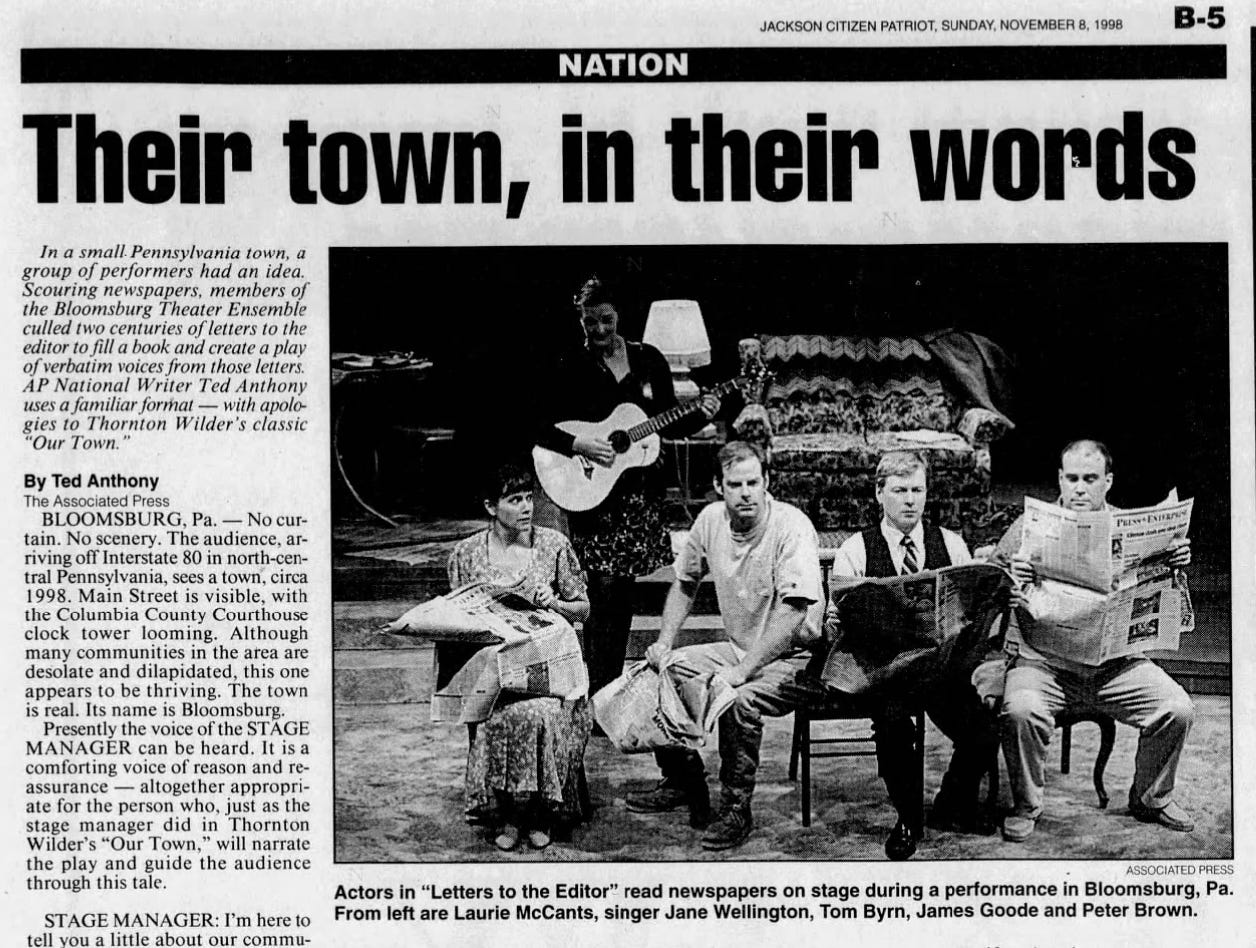
I’m comfortable exploring nonlinear narratives. We receive a lot of our storytelling sensibility as children, inherited from stories that have withstood the test of time — which means that even if if they are genius, they tend toward the conventional and the linear. Because of the constant chaos in my brain (which led to me starting this Substack in the first place, to get some of the chaos out), things tend to come out in odd configurations. I have tried not only to live with that but to harness it, and some of the stories of which I’m most proud have been … unusual. I once wrote an entire story in the style of the play “Our Town.” Said one editor: “Are you nuts?” Said another: “Let’s publish this.” It didn’t do all that well, but I learned a lot from it.
I see life as a collection of fragments. The analogies I used for this are things like Chex Mix and Pinterest boards — chaotic combinations of small things united for a single purpose. By continually rearranging these fragments in my head, I can come up with writing configurations that I otherwise wouldn’t. In short: Instead of narratives that walk straight down the road, I prefer ones that hopscotch — as long as they cohere in the end. This is quite convenient given that the hypertext, short-form, push-alert culture in which we live encourages such behavior. I drowned in it for a long time; now I’m quite comfortable with it — and crave it, even.
I’m instinctively format-agnostic. Though I’m a writer at my core, I tend to see stories as stories first and formats or outputs later. That has helped me immensely in this increasingly multiformat and multiple story-form era of journalism.
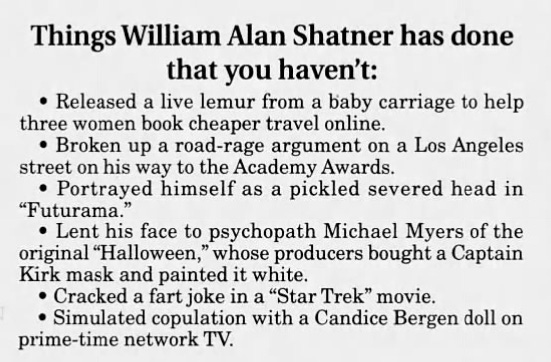
I am willing to venture off of my central thesis if it serves the story. Digressions, used correctly, can enhance the texture and stickiness of a story. In profiling William Shatner years ago, I came upon a bunch of things that didn’t fit the narrative I was crafting but that were just damn interesting. I began collecting them on a separate screen. Then I decided to shove them in the middle of the narrative as a list, sort of like adding some spices on top of the dish to enhance flavor. This is a total ADHD move, I’ve been told since. (Obviously unchained digressions can be incoherent, particularly in daily journalism, so self-control is an indispensable muscle in this respect.)
Instead of constantly battling my monkey brain, I try to harness it. Recently I realized that pinballing among several writing and editing projects or assignments increases the velocity of my brain, and thus my productivity. So whenever possible, instead of excoriating myself for not being able to maintain attention on one thing, I just make sure that my distractions aren’t random — that they’re also things I have to get done. That willingness to pinball rather than feel shame about my distractibility has done wonders for my creativity and my productivity of late.
Rabbit holes don’t stress me out. The opposite of monkey brain is hyperfocus, which is another ADHD trait. This one has been with me forever, at least since I began keeping a notebook of airline logos cut out from magazines when I was 6. I realize that some of my deepest, most enduring interests across the years — collecting stamps and baseball cards (ages 7 to 13), tracing my family history (ages 14 to 58), buying 150+ neckties and an equal amount of loud shirts (ages 22 to 36) writing my book (ages 32 to 39) and even storytelling itself (ages 19 to 58) — are hyperfocus-fueled rabbit holes that have served me quite well in different respects. The trick is being able to manage them and, when needed, climb out again. (I’m still working on that last part.)
Let’s be clear: I’m certainly not saying that this is all positive. For example, I’ve spent far too much money on far too many things over the years in ways that have had detrimental effects on those close to me. But on balance, at this moment in my life as a storyteller and a human being, I am grateful for the directions that this “neurospicy” life, as my friend Katie calls it, has sent me. I will likely be working to harness it as long as I live. But realizing what it is, and shaping it to my own ends rather than simply fretting and watching as it shapes me, is something I wouldn’t trade for anything.
I hope this reflection, which I’ve avoided writing for a few months until tonight, is at least marginally useful for you. Thanks for sticking with me. Unless, of course, you got distracted. And that’s completely fine, too.
And now, Patsy Cline and the Jordanaires.
To Ponder
Do you struggle with similar things as a storyteller? How have you coped with them or harnessed them?
Do you think that ADHD and being a storyteller are fundamentally related? If so, how? If not, why not?
If you’re interested in reading about how everyday life and unusual things shape us, check out my other Substack, Unsorted but Significant:

This is the first article of yours that I have read and I find it compelling. I do not have a formal diagnosis but my grandson has and the knowledge we have gained has explained traits I have struggled with for decades. As a writer/journalist, short pieces appealed to me. Jumping from one subject to the next fit my need to look, write and move on. Now retired, the desire to write a novel allowed me to focus intently-writing everyday for hours-for months. I have no idea how to harness any of it. I recently had major surgery and find it near impossible to get back to my novel. I can't get motivated to start a completely off-the-wall shirt scene. I will be watching your column with interest!
Years ago, a well-meaning editor complimented me but asked why I had to go down so many damn rabbit holes. I thought it was obvious, but realize now it wasn’t: because that’s where the stories are!
It’s the coming back out from the rabbit holes which was tricky sometimes
Love this piece, sharing it w/ some friends