
Do It Again
How calibrated repetition and use of patterns can cut through storytelling static.

One brief musing about storytelling per day (or, more likely, as frequently as I can muster).
Jan. 13, 2026
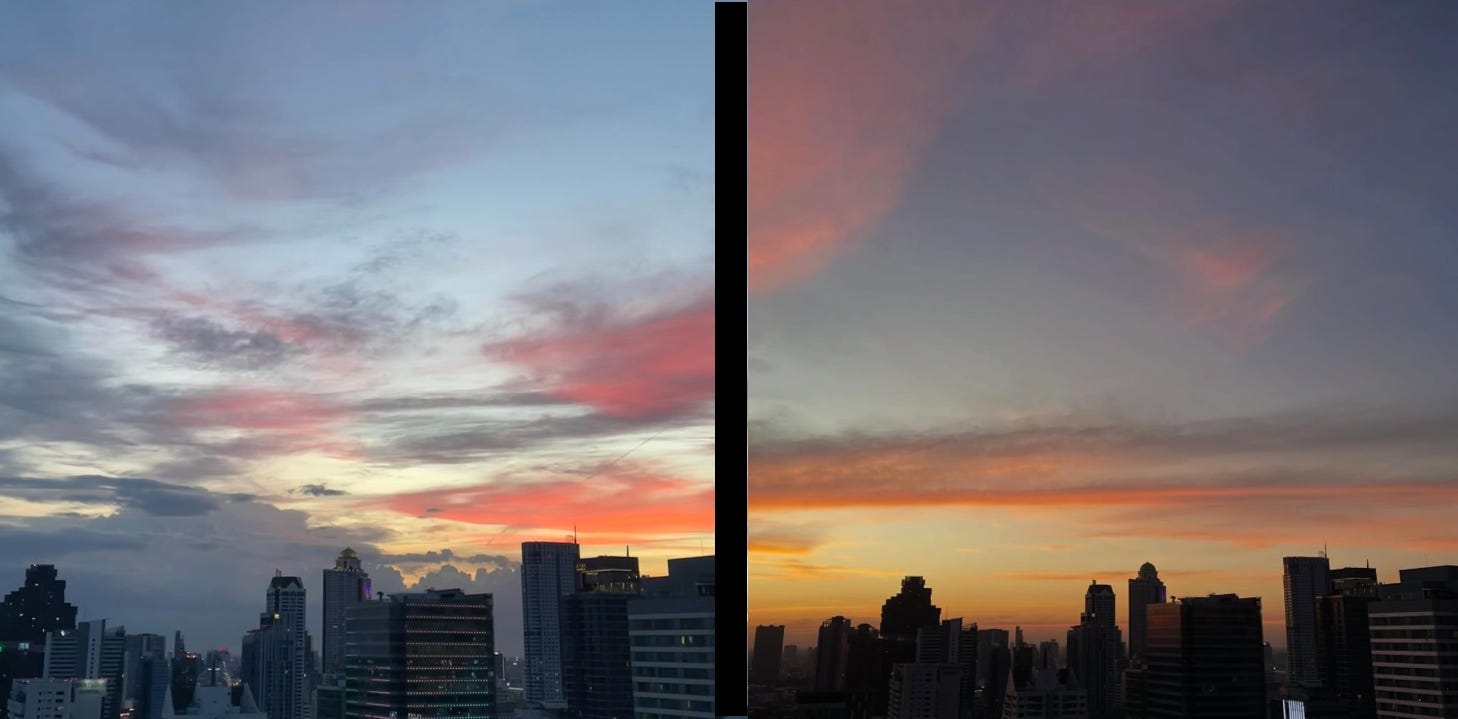
WHEN I LIVED in Thailand from 2014 to 2018, my colleague Christie Hampton had an intriguing approach to her Instagram account. Every few evenings or so, she’d photograph the sunset view from her Bangkok apartment balcony from an identical vantage point. It was the exact same photograph. But of course it wasn’t — weather, seasons, pollution, cloud cover all created striking variations on a theme.
It was enchanting and hypnotic. While I loved the individual photographs, looking at the grid of her account (see below) was like walking into a high-altitude psychedelic dreamscape. It made me feel as if I was moving through time against a canvas of the Thai capital, propelled by colors and clouds. Though I lived on the 27th floor of my own apartment building in Bangkok, with its own frequently arresting views and sunsets — when I visualize the city’s skyline all these years later, I think of the view on her Instagram feed.
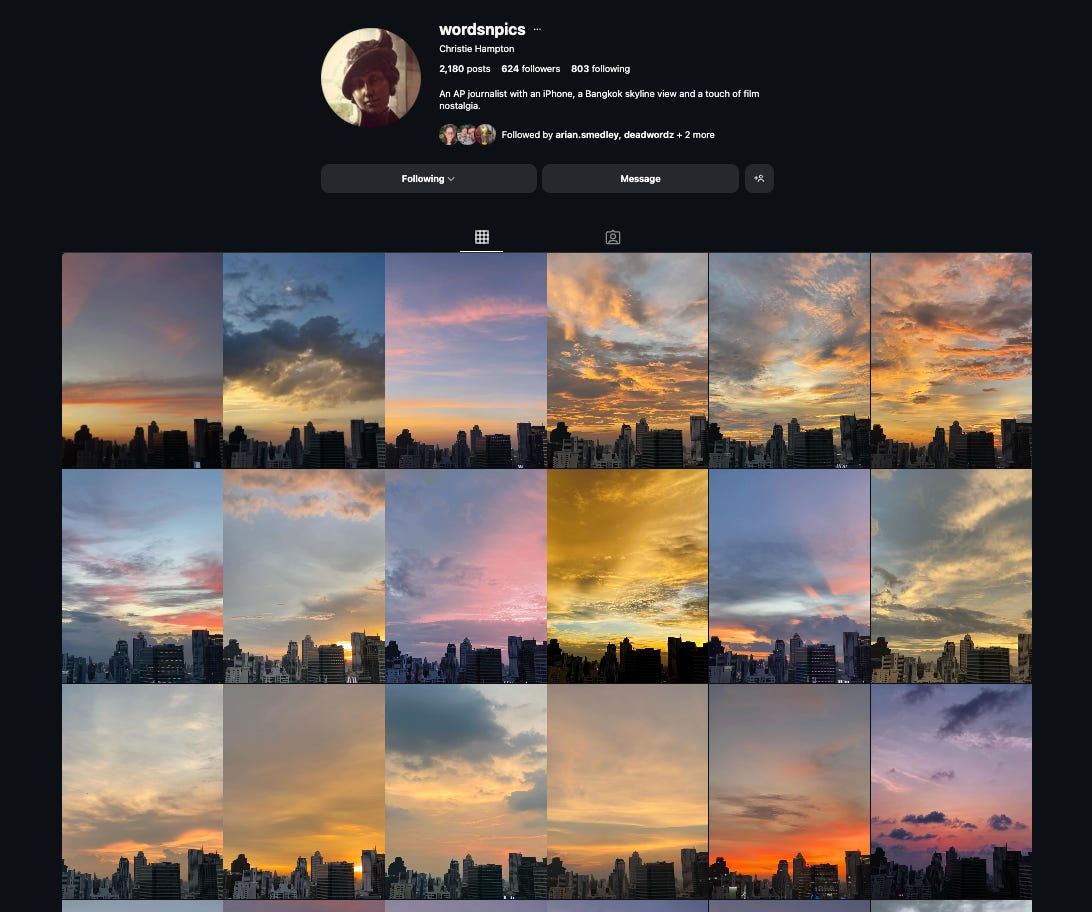
This demonstrates the power of calibrated repetition in storytelling. It’s something we can use in all kinds of different ways if we think about it.
Why did Christie curate her feed this way? Here’s what she has to say:
“I was new to the city and new to social media and I found the sunsets off my balcony consistently interesting, so that’s what I posted. Once I established the pattern, it became more than a string of sunset photos. It showed the change in seasons and the changing skyline of an ever-growing city. Worsening pollution washed out the sky, so much so the sun often disappeared in the haze long before the true sunset. The technology changed — iPhone kept trying to compensate for the low light of sunsets, and Instagram became less of a photography community. Which is all to say it is not what it once was, but that makes it interesting too.”
In short: Not just images, but an actual story that’s unfolding gradually — and a rather epic one at that. And it’s done with no words at all, which I particularly love given that a) she’s a sharp editor of words and b) her account is called @wordsnpics.
I have many pro photographer colleagues who have done all kinds of interesting work relating to patterns. My colleague Jae C. Hong, for example, has done some amazing stuff with shooting images out of vehicles that relies on framing unique subjects within repetition — i.e., the car window. At the COVID-restricted Beijing Olympics in 2022, he did a cool series of frames all shot from roughly the same vantage point called “Blur from the Bus.” The repeating patterns on the inside of the bus made the sights he captured outside the bus even more memorable. Jae is great at this kind of stuff.

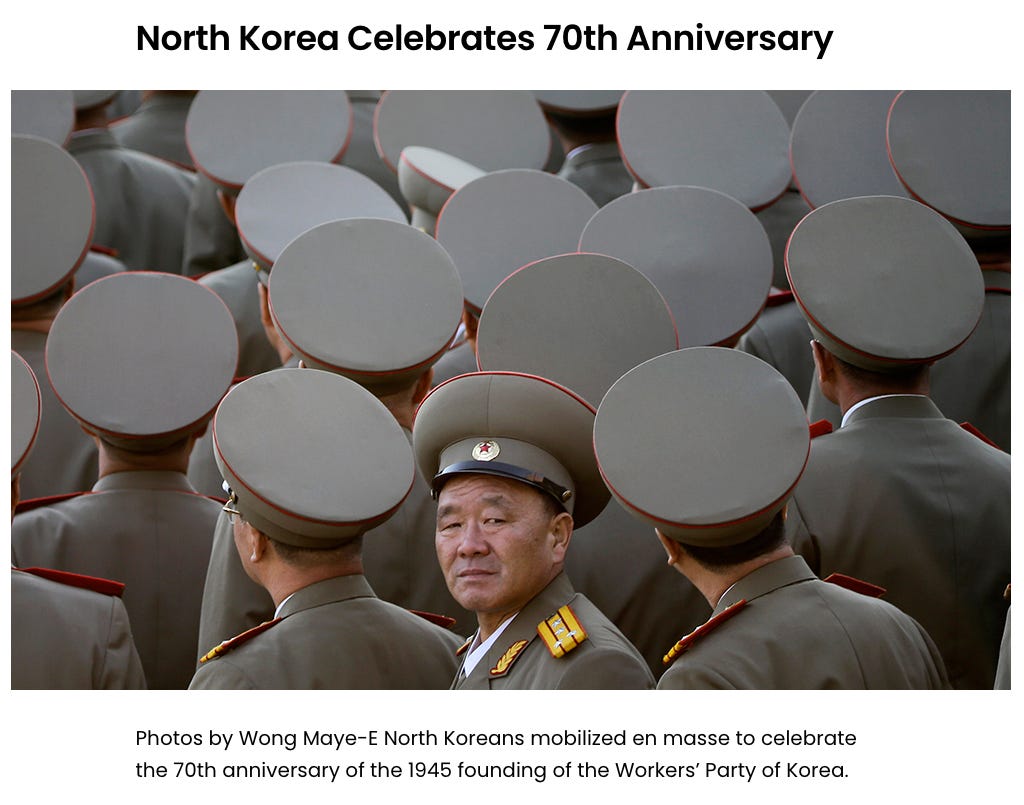
And my friend Wong Maye-E did some really memorable work with repetition in the 2010s in North Korea, where repeating patterns are hallmarks of public spectacle. I was with her in Pyongyang in 2015 on the day she took the photo below, now on the AP Images Blog, and I remember how powerful it was and how we discussed the ways she gravitated toward patterns — and the interruption thereof — to create her unique brand of powerful imagery.
Repetition can be used anywhere you think about it in storytelling, as long as it helps tell the story that you’re aiming to tell. It can be used for, among other things:
Demonstrating and illustrating patterns, obviously.
Showing a pattern for the express purpose of showing the interruption of that pattern, like the North Korean military officer in the photo immediately above.
Lending symmetry or order to something that might otherwise be simply chaotic.
Depicting the way that a place changes or doesn’t change through time (I’ll be tackling that topic specifically in the near future).
Creating a repetitive focal point around which other things can change and tell stories, like a Major League Baseball video from 2024 that showed dozens of still photographs of baseball plays built into a single video. The constant, quick-cut repetition — a baseball at the exact same place in the center of the shot — told the story that no matter what the plays were, the ball was at the heart of the game. (I wish I could link to it or embed it, but I can’t access it where I am at the moment.)
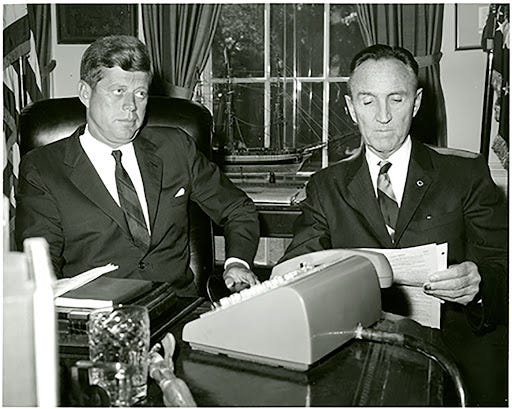
Words, too, can leverage repetition for a powerful emotional or rhetorical effect. One of the most memorable instances of this that I can think of of came from the late U.S. Sen. Mike Mansfield, Democrat of Montana, who eulogized President John F. Kennedy in the Capitol Rotunda in the days after his 1963 assassination.
“There was a sound of laughter and in a moment, it was no more. And so she took a ring from her finger and placed it in his hands.
There was a wit in a man neither young nor old, but a wit full of an old man’s wisdom and a child’s wisdom, and then, in a moment it was no more. And so she took a ring from her finger and placed it in his hands.
There was a man marked with the scars of his love of country, a body active with the surge of a life far from spent and, in a moment, it was no more. And so she took a ring from her finger and placed it in his hands.
There was a father with a little boy and a little girl, and a joy of each in the other, and in a moment it was no more. And so she took a ring from her finger and placed it in his hands.
There was a husband who asked much and gave much, and out of the giving and the asking wove with a woman what could not be broken in life, and in a moment it was no more. And so she took a ring from her finger and placed it in his hands, and kissed him, and closed the lid of the coffin.”
For the most accessible examples of repeating patterns in storytelling, we can look to song lyrics — and to choruses in particular. Consider “American Pie,” in which Don McLean leads us through an allegorical patchwork quilt of American music from 1959 to 1972, but always anchors us back to the root lament:
So bye bye, Miss American Pie.
Drove my Chevy to the levee
but the levee was dry.
And them good ol’ boys
were drinkin’ whiskey and rye,
and singin’, ‘This’ll be the day that I die.'
By the time he comes back to that chorus one final time — slow and mournful, with none of the bounce he gave it during the song’s earlier refrains, the funereal flavor of his lament is clear. And the last chorus — exactly the same, yet very different — hits like a lightning bolt even after all these decades.
It’s repetition as buildup to a final, powerful statement — storytelling at its most impactful. And you can find ways to do this in your stories as well — by thinking about patterns, repetition and how they might best serve the tale you have chosen to tell.
Speaking of the choruses of songs: And now, the Kinks.
To Ponder
What stories might be told better or more powerfully with repetition? How can it be used in the format in which you’re working?
How might you tell a story with recurring patterns without it becoming redundant and thus boring?
How might repetition be a part of a story you’re working on without becoming the entire story itself?