
Danger Zone
Curation and distortion: The 'perilous' 1980s, through the eyes of safety videos.

One brief musing about storytelling per day (or, more likely, as frequently as I can muster).
April 8, 2026
PLEASE TAKE HEED: I’ve fallen, and I can’t get up.
If that phrase means anything to you other than being concerned about me (which is not needed), odds are you were watching television during the 1980s. We also needed, in those days, to say NO to drugs. We needed to worry about Soviet nuclear missiles and burning our thighs on metal park slides and losing an eye to a lawn dart purchased by … our own parents. And, if prime-time TV was any indication, we had to be quite careful during our daily peregrinations not to get caught in what seemed to be a ubiquitous peril: quicksand.
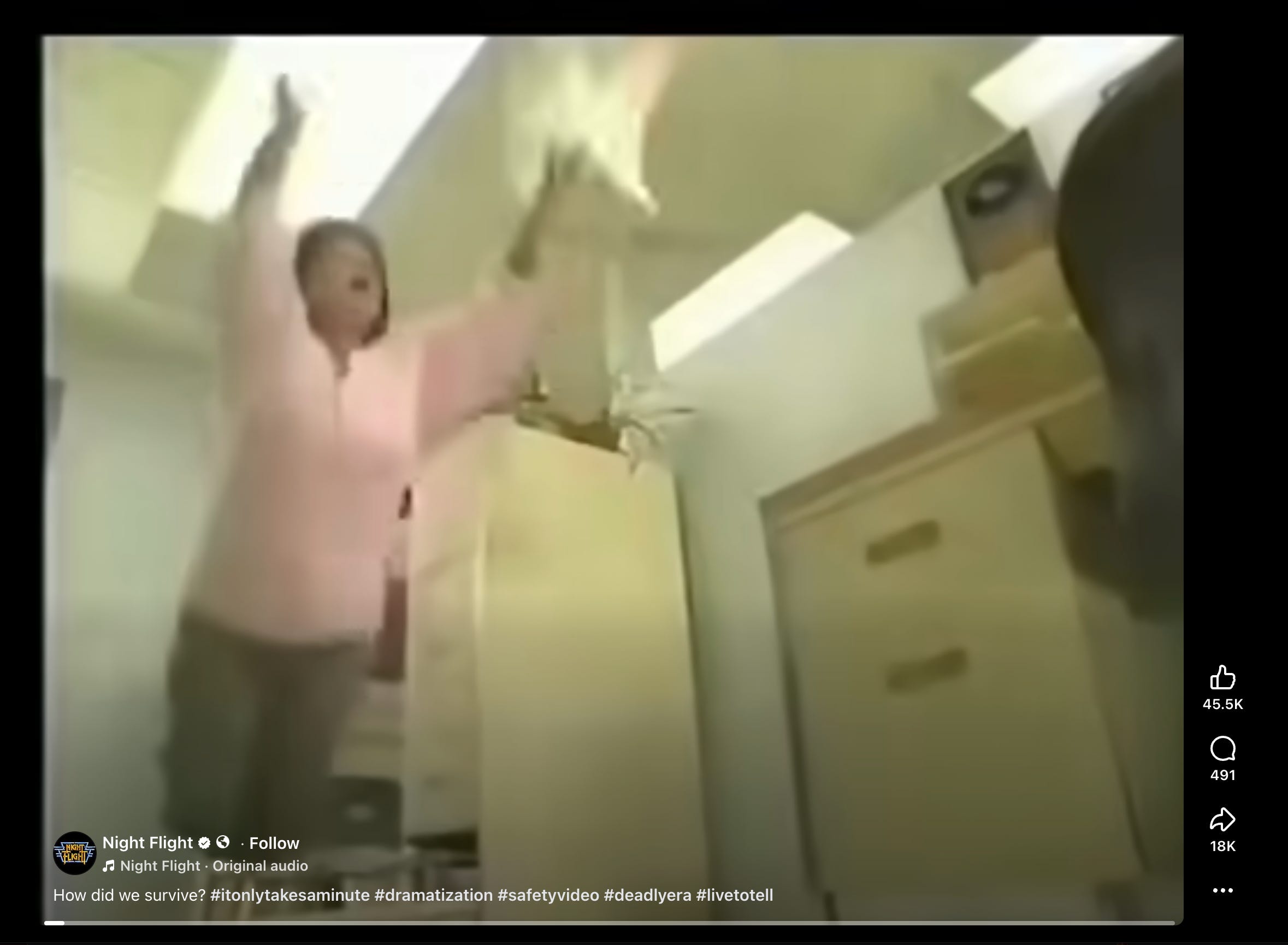
Apparently we also REALLY needed to worry about bloody, bone-crushing accidents in the workplace and the home. Which I didn’t realize, and I was there the whole time.
Due in part, I’m sure, to the newfound availability of small camcorders and VCRs, there is no shortage of industrial safety videos from the Reagan era kicking around YouTube. But when I found this supercut of 1980s and 1990s safety videos recently, I was struck by the impact of all the don’t-let-this-happen-to-you imagery all in one place. It made it even more clear that the makers of these videos cut their teeth (and presumably other things) on Warner Bros. cartoons on Saturday mornings.
Now, I can’t 100% swear this one isn’t AI, but I have looked hard at these images multiple times and they feel real (well, real as in actual imagery, not real as in “not staged”).
You see people go flying after tripping over open file drawers. People getting sprayed in the eye with volatile chemicals. Warehouse employees collapsing as heavy boxes rain down on them from above.
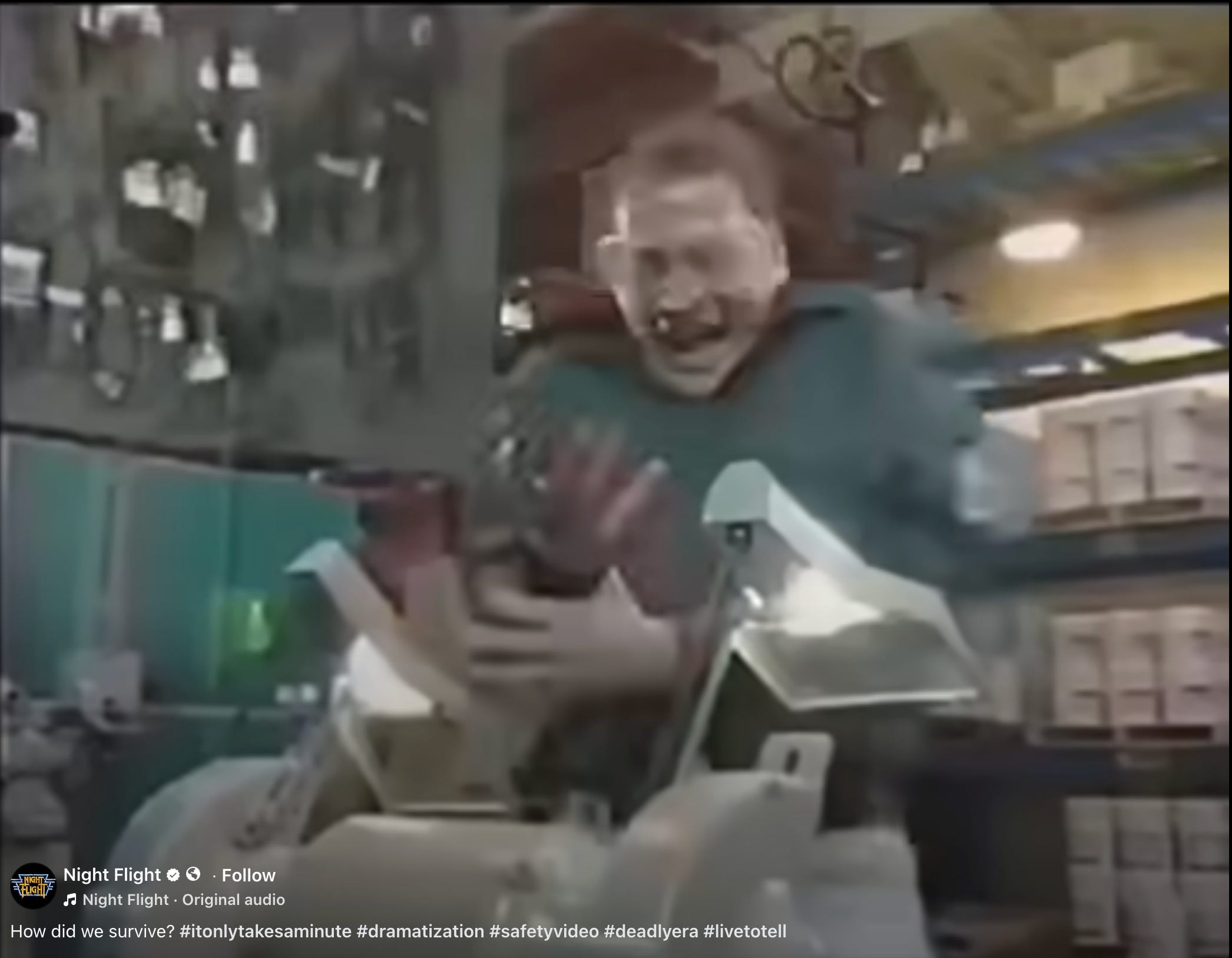
A man backs into a garage, running over a child, who goes flying (and noticeably turns into a limp dummy after the moment of impact). A supermarket worker with a box cutter slips on the floor of the cereal aisle, slicing open the vein in her wrist with incredible precision — and we get to see the blood. Another man gets crushed by heavy machinery and yells for help as the metal closes in “Star Wars” garbage-chute style.
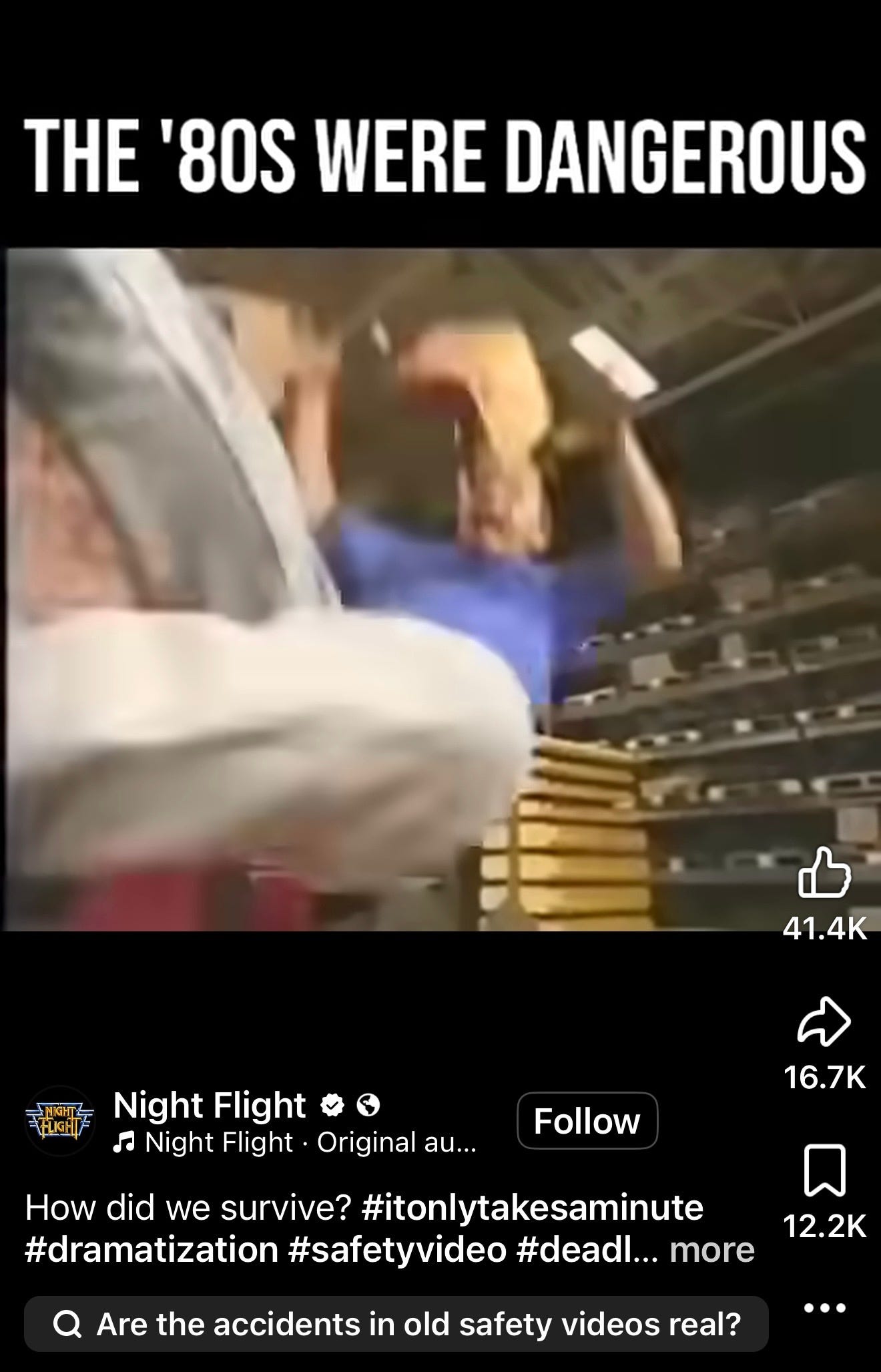
Deep in the unused part of my brain, I remember snippets of this “Scared Straight!” approach to 1980s safety. But to see them all together — well, that’s why we’re here today.
I wrote some years ago about the compression of complex American decades into popular culture tropes that elide actual history for iconography and broad-brush portraits. The 1950s? Sock hops, moms wearing dresses to do the dishes, car tailfins and rebels without causes. The 1960s? Tie-dye and peace signs and psychedelics and hippies — and rarely any mention of efforts to eliminate race and gender inequities. The 1970s? Pet rocks and “Have a Nice Day” stickers and leisure suits and — on a particularly realistic day — expensive gas.
This safety video, in a way, does sort of the same thing.
First, to look at this video is to play into the Gen-X trope (which I partially buy into) that the 1980s and early 1990s were a time when adults were oblivious, kids were feral and anything could happen.
That produces two thoughts about storytelling that I want to call out here:
Curation. What you pick and how you arrange it is not something in addition to the story; it’s part of the story. Curation offers great power to clarify, to make a case — and to distort. Which brings us to …
Distortion. When you’re choosing your elements of your story, ask yourself (unless you’re doing fiction): Does this accurately represent the story I’m trying to tell? Are there elements that shade it toward something unrealistic? Is it alarmist and overheated? Is it fair?
In terms of fairness: Clearly, these videos were filmed individually to make a point and stop people from getting hurt. They’re not journalism and not intended to be. But as a cultural document, viewed from four decades later, they offer a broadly skewed a view of the era as much as a period film that only showed people in leg warmers or Duran Duran haircuts or purples and pinks.
Gotta go now. In writing this, I’ve fallen into a rabbit hole trying to find the “don’t drive recklessly” educational film that I saw in Mr. Farmerie’s driver’s education class in 10th grade that featured Vincent Schiavelli from “One Flew Over the Cuckoo’s Nest” as a post-car-accident corpse. Good times.
See you tomorrow. And now, Kenny Loggins.
To Ponder
What can you think of that would tell a reasonably accurate story on its own but change entirely if you stacked it up with other examples of the same thing?
Have you used the notion of the “supercut” to tell a story other than one about your hair appointmment.
What story forms could this style of visual aggregation help you tell?
This post was updated on April 9 to add that the videos are also from the 1990s.
If you’re interested in reading about how everyday life and unusual things shape us, check out my other Substack, Unsorted but Significant:
