
As You Walk On By
A child's comment about polio, and telling stories about how we got here.

One brief musing about storytelling per day (or, more likely, as frequently as I can muster).
March 13, 2026
FIFTEEN YEARS AGO, on a Wednesday morning in December, my 8-year-old son came at me out of the blue with a question that echoes in my head to this day:
“Dad, what’s polio?”
He was asking, it turns out, because in the 1950s the school he attended had been used to test Jonas Salk’s vaccine. He’d had a lesson in his third-grade class about the disease, the things it took from so many and the role his school had in helping eradicate it (it was tested there, and Salk’s kids attended the school).
That day, I recorded my son’s comment in my journal under the heading, “Department of Societal Blessings Uncounted.”
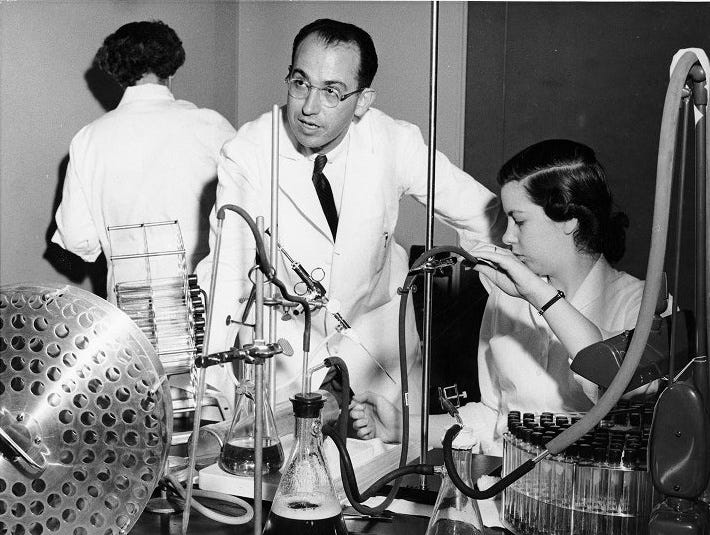
Why did I unearth this anecdote? I’ve been thinking a lot lately about journalism and writing in general that tells us an important thing we often disregard or simply forget to consider: how we got here — wherever “here” might be. Sometimes, the luxury of not knowing is noteworthy. (I guess it makes sense for me to be interested in this, given my interest since my childhood in family history — probably the ultimate personal expression of the “how we got here” ethos.)

In the case of polio, the vaccine debate in recent years has raised the how-we-got-here question once again. As screenwriter and documentarian Carl Kurlander of the University of Pittsburgh wrote in December:
Near the end of his life, Salk would say sometimes he would run into people who didn’t know what polio was, and he found that gratifying. But today the world is paying a high price for those who don’t remember what life was like before these events and now question the value of vaccines. The polio virus may not be visible, but it is still with us.
It reminds me of one of my favorite history podcasts, “The Road to Now” — which, as its title implies, tries to draw connections between things that happened before we came onto the human stage but that shape our lives today.
In a fragmented media era (God, how many sentences have I started by using that phrase?), context is more important than ever to understand the chaotic and jumbled forces that shape us. Storytelling around context is also something that people hunger for — hence the rise of the “explainer” in media in recent years.
So as you say, “How should this story be told?”, consider asking the following question as well: Where did all this come from? When it comes to this subject, what is the road to now?
And now, Simple Minds.
To Ponder
Whatever you cover or write about, take a moment to consider: What kinds of compelling stories can be told about context — about the “road to now” in your particular subject?
How can you best incorporate history into your regular work without it sounding like a set piece or an encyclopedia entry?
What in your area of interest has been forgotten — and how might remembering it serve your audience?
Very interesting piece!! Quick aside: people born in China between the 1960s and the early 1990s mostly received the oral polio vaccine introduced by Albert Sabin in 1960. In China it came as little sugar balls.
A lot of us share almost exactly the same childhood memory. At nursery or kindergarten the teachers would call us out into the courtyard, line us up, and place the sugar ball in our mouths one by one — almost like a priest placing the host in a communicant’s mouth.
I believe the Japanese photographer Ryoji Akiyama also took photographs of scenes like this.